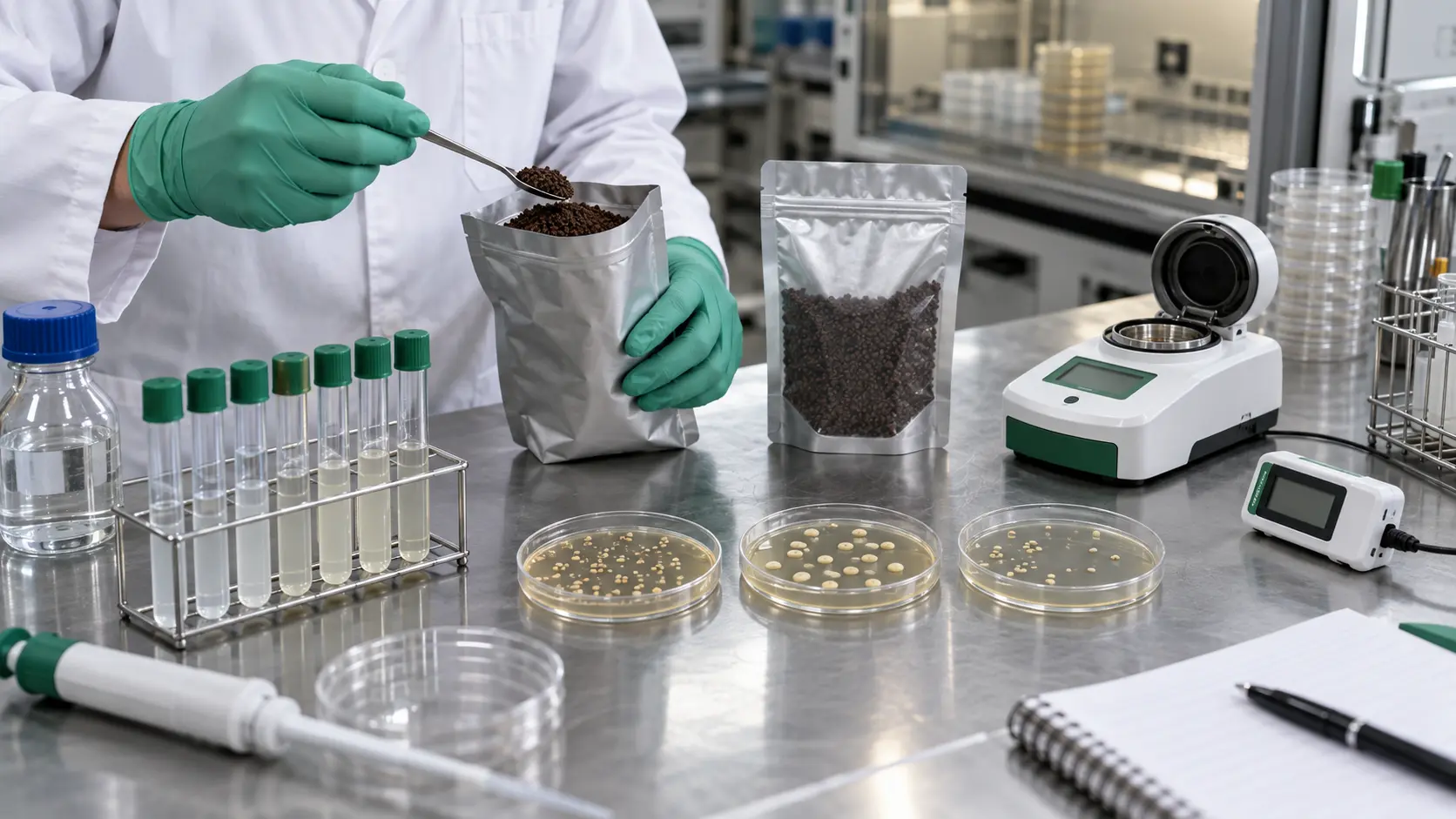
A Bacillus name on a label is not a shelf-life result. A defensible microbial product must connect the declared strain or strain set to a defined test method, a representative commercial lot, sealed packaging and measurements made across the claimed storage period. Viable count at manufacture is only the first time point; it cannot by itself establish what reaches the buyer near expiry.
For a humate-based spore formulation such as Bio-BS WSG, the useful question is not whether Bacillus spores are generally robust. It is whether the specified organism can be recovered reproducibly from this exact matrix, remains within the approved specification in the intended pack, and passes identity, purity and physical-stability gates. No literature value can replace the product’s own method validation, applicable market requirements or real-time lot data.
KEY TAKEAWAYS
- Freeze the strain, matrix, pack, market and method before testing a lot.
- Treat viable count, identity, contamination and physical stability as separate gates.
- Use real-time sealed retain samples across multiple lots to support expiry.
- Do not infer field efficacy from a passing viable-spore result.
1. Define what the specification actually covers
Begin with the taxonomic identity required by the applicable label or dossier, the formulation matrix, package type, storage statement and sampling unit. Write the viable-spore method into the specification rather than listing only a result. Genus-level identification is not interchangeable with strain identity, and a specification for one carrier, pack or market must not be silently transferred to another. Set acceptance criteria only from the applicable regulatory, registration and product-development evidence—not from a competitor page or an unrelated paper.
2. Sample the commercial lot, not an ideal jar
Approve a written plan that identifies the lot boundaries and selects sealed units across the beginning, middle and end of filling or other justified positions. Record package code, sampling date, sampler, seal condition, storage history and transport to the laboratory. Homogenisation and compositing can mask within-lot variation, so use them only when the sampling objective and method justify them. Reserve untouched units for confirmation and future stability time points; repeatedly opening one pack changes the very package system being studied.
3. Validate recovery and viable-spore enumeration in the matrix
A plate count reports colony-forming units recovered under a defined extraction, dilution, medium, incubation and counting rule. It does not count every cell or prove strain identity. The dark, particulate humate matrix can affect dispersion, visibility and recovery, so demonstrate repeatability, recovery, working range, dilution controls, negative controls and analyst rules on the actual formulation. If a validated heat step is used to estimate spores rather than vegetative cells, define its conditions and prove that the chosen strain and matrix behave as intended.
Total microscopy, optical density, DNA detection and viable plate count answer different questions. Do not convert one into another without a validated relationship. Report the method, sample basis, replicate results, calculation, reporting limit and measurement uncertainty or observed method variability beside the final value. An unexpected result should trigger investigation and confirmation, not selective re-plating until a convenient number appears.
4. Keep identity, purity and physical stability as separate gates
A passing viable count does not exclude an unwanted organism, confirm the declared strain or show that the product will disperse as intended. Use validated identity and contamination procedures appropriate to the product and market. Track relevant physical attributes such as moisture or water activity, appearance, flow, caking, package seal and reconstitution behaviour when they are part of the approved specification. Investigate trends together: a moisture shift, damaged barrier or clumping event can explain a viability change without replacing the microbiological result.
5. Build shelf life from real-time, sealed time points
Place independently sealed retain units from multiple representative lots under the labelled storage condition. Define time zero, intermediate checkpoints and a point through the proposed expiry before reading results. Test the same critical microbiological and physical attributes with controlled methods, and document temperature excursions. Accelerated heat or humidity studies can rank formulations, packages and risks during development, but they should not replace real-time evidence unless a validated predictive model and the applicable authority support that use.
6. Turn the evidence into a bounded lot decision
The release record should identify the exact lot, product version, pack, market specification, analytical methods, laboratories, dates and deviations. Compare each result with its pre-approved criterion and document release, hold, investigation or rejection. The certificate of analysis should state what was measured and by which method; it should not turn viable-spore compliance into a claim of crop efficacy. Seed, root or soil performance belongs to a separate, labelled-use trial with suitable controls and agronomic endpoints.
PRACTICAL ANSWERS
Frequently asked questions
Are Bacillus spores automatically stable until expiry?
No. Stability belongs to the exact strain, formulation, process, package and storage condition and must be supported through defined time points.
Is a CFU count the same as a total cell or DNA count?
No. CFU measures culturable units under stated conditions. Total-cell and DNA methods answer different questions and are not interchangeable without validation.
Can an accelerated study alone establish the expiry date?
Usually not. It is useful for development and risk ranking, while the commercial claim normally needs real-time evidence unless a validated model and applicable rules support another route.
Does a passing viable-spore count prove field efficacy?
No. It is one quality gate. Agronomic efficacy requires a separate trial for the intended crop, route, label and local conditions.
Technical references
- Peer-reviewed study: Storage stability of spore-based bacterial agricultural biopreparations
- Peer-reviewed review: Maintaining and assessing viability in bacterial inoculant formulations
- Government quality-control publication: Fertiliser Control Order 2023 Green Book
This article provides product-selection and operating logic, not a legally binding application rate. Final use follows the registered label, batch documentation, water and soil analysis, and local technical guidance.