Bulk potassium humate offers are often reduced to one headline percentage and a claim of complete solubility. That is not enough for a fertilizer manufacturer. Two powders carrying the same nominal humic value may have been measured by different methods, reported on different bases and behave differently in dissolution, filtration, dry blending, storage or the finished formulation.
A defensible purchase specification therefore links identity, test method, reporting basis, process performance, documentation and lot acceptance. This guide sets out that chain. It does not propose universal acceptance limits: those must be defined for the target market, formulation, equipment, registered label and contractual batch specification.
KEY TAKEAWAYS
- Never compare declared humic values until the analytical fraction, method and reporting basis are aligned.
- A solubility claim is incomplete without water chemistry, concentration, temperature, mixing time, agitation, filtration and residue criteria.
- The supplier CoA supports traceability; it does not replace independent qualification and incoming-lot checks.
- Release the raw material only after the lot passes the agreed identity, document and process-performance checks.
1. Define the material before comparing percentages
Start with source material, extraction route, counter-ion, physical form and intended manufacturing function. “Potassium humate” identifies a product family, not a complete grade. A fine powder intended for controlled industrial blending and an agglomerated microgranule designed for lower-dust handling may share chemistry while serving different process needs.
Write the intended use into the request for quotation. Is the material a raw ingredient for dry blending, a concentrate for liquid formulation, or a finished input for professional application? The answer determines which particle, moisture, residue, packing and documentation characteristics are critical.
2. Align the analytical method and reporting basis
ISO 19822 specifies determination of humic acids and hydrophobic fulvic acids in fertilizer materials, soil amendments and geological deposits. The validated AOAC procedure behind this analytical family uses alkaline extraction, acid precipitation and resin separation, with gravimetric reporting on an ash-free basis. This operational definition matters: a result from another extraction, fraction or calculation basis is not automatically equivalent.
For every declared value, state the analyte, method, laboratory, unit and basis—dry matter, as received or ash free. Moisture can make a dry-basis figure appear higher than its as-received equivalent. The same discipline applies to potassium expressed as elemental K or K₂O and to ash, pH and insoluble residue.
3. Build a specification matrix that predicts process risk
Set acceptance limits only after the formulation and manufacturing process have been qualified. A tighter number is not automatically a better specification; it must control a real risk and be measurable with sufficient precision. Define the action for an out-of-specification result before orders are placed.
| Specification block | Record explicitly | Decision supported |
|---|---|---|
| Identity | Source, extraction route, counter-ion, form and intended use | Whether the grade matches the formulation route |
| Composition | Humic fractions, method, basis, K or K₂O, moisture and ash | True like-for-like comparison |
| Solution behaviour | Test water, loading, temperature, time, agitation, filter and dry residue | Tank, filtration and downstream suitability |
| Powder handling | Particle distribution, bulk density, dust, hygroscopicity and caking tendency | Feeding, blending, packing and storage design |
| Compliance and lot | Target-market limits, CoA, TDS, SDS, label, lot code, origin and retained sample | Regulatory release and traceability |
4. Translate “100% soluble” into a reproducible test
A visual disappearance of powder is not the same as a defined dissolved fraction. Fine suspended particles can pass unnoticed in a dark solution yet remain relevant to filters, nozzles or a liquid product’s sediment stability. Specify water conductivity, hardness and alkalinity; powder loading; temperature; addition order; mixing energy and time; settling period; filter opening; and how the retained dry residue is calculated.
Repeat the test in the purchaser’s actual process water and at the intended operating concentration. Then test the complete formulation, because compatibility cannot be inferred from the raw material alone. Final use must follow the registered label, batch documentation, water analysis and local technical guidance.
5. Qualify the supplier, then qualify every incoming lot
A CoA is evidence about the named lot, not proof that every delivery will behave identically. Trend moisture, residue and other critical attributes across lots. Investigate changes against supplier process, season, source material, storage and sampling before accepting or rejecting a causal explanation.
- Issue one controlled specification and test protocol with the request for quotation.
- Obtain a representative pre-shipment sample and verify critical values in a competent independent laboratory.
- Run a pilot dissolution, filtration, mixing and storage check in the intended process.
- Approve a reference lot and retain a sealed reference sample under documented conditions.
- At receipt, reconcile supplier, lot code, seals, CoA, packaging and transport condition; sample by an agreed plan before release.
6. Connect documents, product form and logistics
The technical file should include the current TDS, lot-specific CoA, SDS, label specimen where applicable, origin and traceability records, packaging specification, pallet pattern, net and gross weights, storage conditions and transport protections. EU fertilising-product documentation requirements depend on the product’s regulatory route; Regulation (EU) 2019/1009 requires technical documentation and label information for products placed on that market. Confirm the applicable category and national requirements with qualified regulatory guidance.
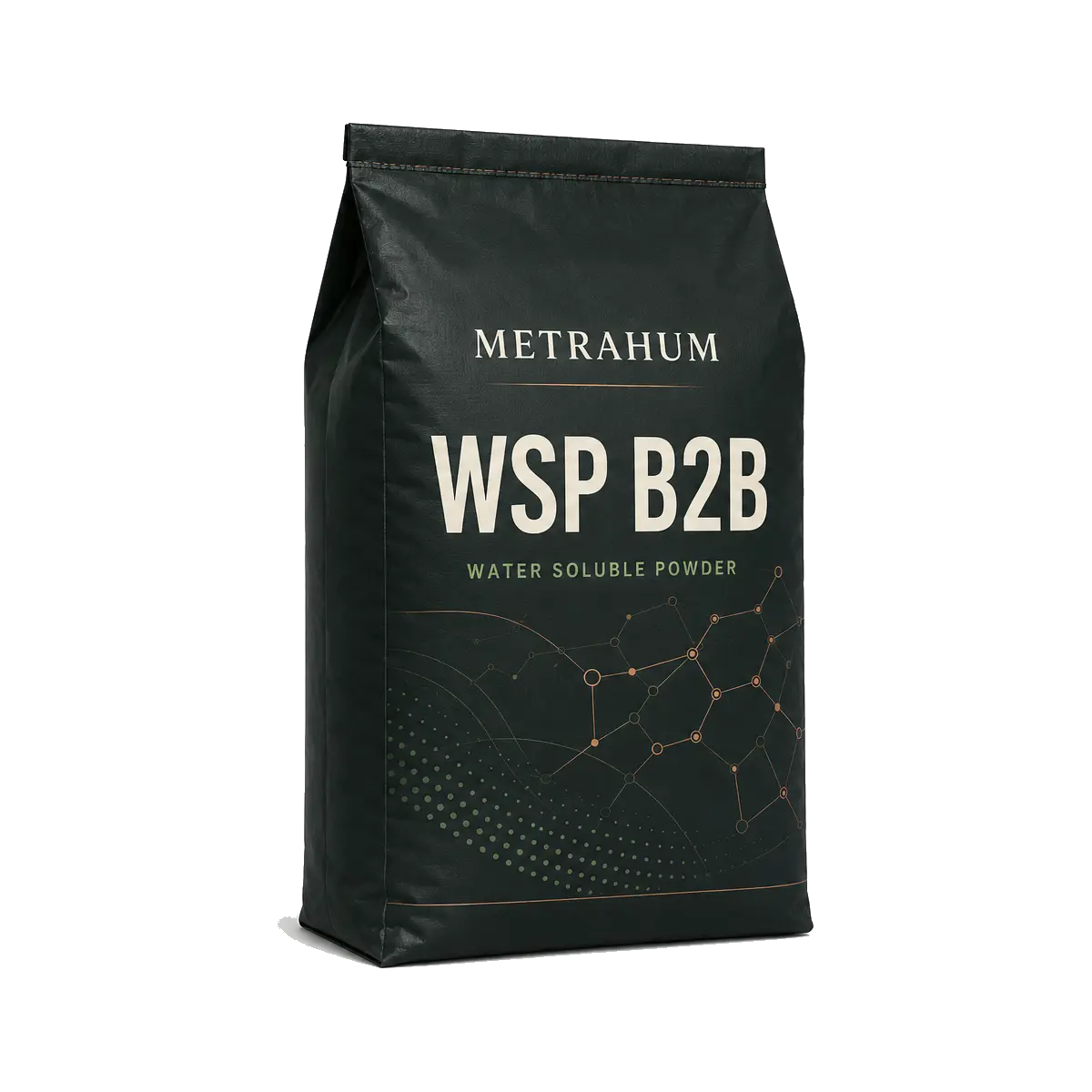
For MetraHum’s focused portfolio, WSP B2B is the relevant route when a fertilizer manufacturer needs a fine industrial powder for controlled blending or custom formulation. WSG Core is an agglomerated water-soluble microgranule route where handling and application form are part of the decision. Neither page substitutes for a signed specification: final composition, compatibility, packing and release criteria remain contract- and batch-specific.
PRACTICAL ANSWERS
Frequently asked questions
Which specification matters most when buying potassium humate powder?
There is no single decisive number. First align identity, analytical fraction, method and reporting basis; then control moisture, ash, potassium expression, insoluble residue, particle behaviour and the attributes critical to the intended formulation.
Does “100% water soluble” guarantee trouble-free filtration?
No. The claim is not reproducible without defined water, concentration, temperature, mixing, settling, filter and residue conditions. Verify the raw material and complete formulation in the actual process water and equipment.
Can two supplier offers be compared by humic percentage alone?
No. The results may represent different analytical fractions or bases. Require the method, units, moisture basis, ash treatment and laboratory information before comparing price per unit of declared material.
Is a supplier CoA sufficient for lot release?
Not by itself. Reconcile the CoA with lot identity and shipping documents, inspect packaging and transport condition, take a representative sample and perform the risk-based incoming tests defined in the purchase specification.
When should a buyer consider powder instead of microgranules?
Fine powder can suit controlled industrial blending or custom formulation where the plant manages dust, feeding and moisture. Agglomerated microgranules can be preferable when handling form and lower dust are process priorities. Validate both in the actual equipment and final formulation.
Technical references
- ISO 19822:2018 — Fertilizers and soil conditioners: determination of humic and hydrophobic fulvic acids
- Journal of AOAC International — Standardized method for humic and fulvic acids
- European Union — Regulation (EU) 2019/1009 on fertilising products
- Humic Products Trade Association — Certification and approved analytical methods
This article provides product-selection and operating logic, not a legally binding application rate. Final use follows the registered label, batch documentation, water and soil analysis, and local technical guidance.