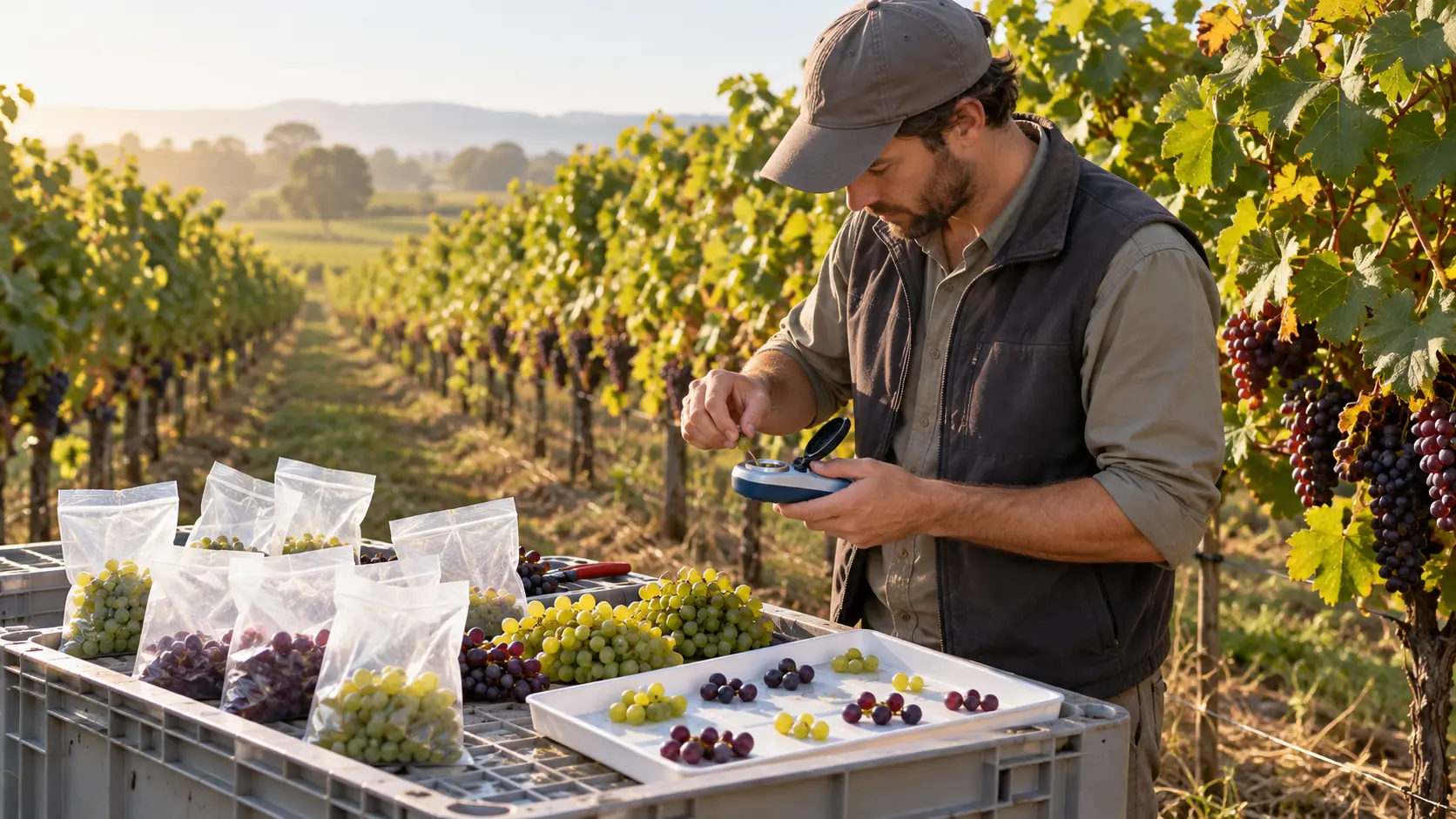
A higher refractometer reading can coincide with sweeter fruit, but it can also reflect a later harvest, smaller fruit, lower water content or uneven sampling. Brix is an estimate of soluble solids in juice; in a complex fruit sample it is not a direct assay of one sugar and it cannot, by itself, prove that a humic treatment improved commercial quality.
Published trials do not point in one universal direction: responses differ by crop, season, formulation, treatment route and measured endpoint. A defensible purchase decision therefore needs a local control, randomized replication, a fixed harvest rule and a quality panel that includes yield and acidity as well as Brix.
KEY TAKEAWAYS
- Treat Brix as one soluble-solids measurement, not as a universal score for sugar, nutrition or plant health.
- Hold harvest maturity, crop load, irrigation and sampling rules constant before attributing a difference to treatment.
- Decide with marketable yield, Brix, titratable acidity and crop-specific quality limits together—not a selected high reading.
1. Define the decision before reading Brix
Write the decision as a testable statement: for one named crop, cultivar, block and market, does the permitted humic programme change marketable yield or the agreed harvest-quality panel under the same management? Do not start with a promised Brix gain. Define the commercial endpoint first: fresh-market acceptance, processing specification, harvest timing or a product-qualification decision.
WSG Core and K18 can be evaluated as separate humic programme routes, but this article does not assign them a universal crop, timing or rate. Use only the current locally applicable label, confirmed water and system compatibility, and a written protocol. A result obtained with one formulation or route does not establish the performance of the other.
2. Build a fair harvest trial
Use an untreated or standard-program control and repeat both treatments across comparable field or orchard blocks. Randomize treatment placement within each block. The plot—not each berry or fruit—is the experimental unit. Multiple fruits from one plot improve its estimate but do not create extra replications.
Keep cultivar, rootstock, plant age, pruning, crop load, thinning, irrigation, nutrition, crop protection and canopy exposure the same. Map weak rows, edges, slope and soil changes before randomization. If these differ by treatment, a Brix difference cannot be assigned cleanly to the humic programme.
3. Lock harvest and sampling rules
Choose one harvest rule before seeing the data: the same calendar date, the same commercial maturity threshold or repeated measurements along the ripening curve. Each answers a different question. Harvesting each treatment when it looks ready can convert a maturity difference into an apparent quality effect; harvesting on one date may instead test whether ripening was advanced or delayed.
Sample across the whole replicate, not from the sunniest cluster or largest fruit. For grapes, rotate berries among cluster shoulders, centre and tail and among canopy positions. For larger fruits, define tree position and fruit sector. Use the same count, time of day, handling delay, temperature correction and instrument calibration for every plot.
4. Measure a quality panel, not one attractive number
At minimum, record total and marketable yield, rejected fraction and reason, fruit or berry weight, harvest date, Brix or soluble-solids content, titratable acidity and the crop-appropriate Brix-to-acidity relationship. Add firmness, colour, dry matter, size class or storage loss only when the market specification makes them relevant.
Measure and report the acid basis and endpoint consistently; acidity values expressed as different acids or titration endpoints are not directly interchangeable. Likewise, document whether the Brix value came from a single fruit, pooled juice or the mean of individual readings. The method is part of the result.
| Possible explanation | Record that tests it |
|---|---|
| True treatment response | Randomized plot means repeated across blocks and seasons |
| Later maturity | Repeated Brix, acidity, colour and harvest-date series |
| Concentration from smaller fruit or water status | Fruit weight, size distribution, irrigation and weather record |
| Sampling bias | Predefined positions and the same subsample count per plot |
| Commercial improvement | Marketable yield plus the buyer’s full acceptance specification |
5. Interpret the whole response
A Brix increase with unchanged or improved marketable yield and an acceptable acidity profile may justify another validation cycle. The same increase alongside smaller fruit, reduced yield, excessive dehydration or out-of-spec acidity is a trade-off, not an automatic success. No difference is also useful: it sets a local boundary for the tested crop, season, formulation and programme.
Do not transfer a statistically significant result from another crop, cultivar, source material or application route into a product promise. Treat season as evidence, not noise: repeat when weather, crop load or water status can change the response. Preserve raw plot records and confidence intervals so a small numerical difference is not promoted merely because it looks positive.
6. Make a product-qualification record
Close the trial with one of three decisions: reject the quality claim for the tested conditions, repeat because the response is uncertain or season-specific, or advance to a larger commercial strip while keeping the control. Record the exact lot, label, formulation, preparation, route, dates, water source, companion inputs and deviations. Without traceability, a later result cannot confirm or contradict this trial.
The outcome belongs to the tested programme, not to every humic product. Use the record to qualify WSG Core or K18 only when that exact route was tested under the applicable label. Combine agronomic evidence with the programme’s full cost and the buyer’s acceptance limits before scaling; a quality measurement without an economic and market endpoint is incomplete.
PRACTICAL ANSWERS
Frequently asked questions
Does a higher Brix value mean that humic acid increased fruit sugar?
Not by itself. Brix estimates soluble solids and can change with maturity, fruit size, water status and sampling. Compare randomized plots under the same harvest rule and read Brix together with acidity, yield and crop-specific quality criteria.
Should every treatment be harvested on the same date?
It depends on the question. A common date can test a shift in ripening; a common maturity threshold compares quality at similar maturity. Choose before seeing results and document repeated maturity measurements so the interpretation is clear.
How many fruit readings count as replication?
Fruit readings within one plot are subsamples. Replication comes from independently treated plots or blocks. Pool or average subsamples within each plot, then compare true replicate plot means.
Can a result be transferred from grapes to other fruit crops?
No direct efficacy transfer is justified. Grape examples explain measurement and sampling, but each crop, cultivar, market, formulation and route needs local validation under its applicable label.
Technical references
- OIV — Evaluation by refractometry of sugar concentration in grape musts
- University of Minnesota Extension — How to measure grape cluster ripeness
- University of Minnesota Extension — How to do research on your farm
- Frontiers in Plant Science — Humic-acid-based biostimulants in wine grape
- Agronomy — Humic-acid preparation, strawberry yield and fruit quality
- FAO — Small-scale postharvest handling: using a refractometer
This article provides product-selection and operating logic, not a legally binding application rate. Final use follows the registered label, batch documentation, water and soil analysis, and local technical guidance.