Granular and powdered leonardite may originate from the same natural matrix, yet they are not operationally interchangeable. Particle-size distribution changes dust generation, wind sensitivity, hopper flow, spread width, segregation risk and where the material is placed in the soil. The form decision is therefore an application-engineering decision, not a cosmetic preference.
A label such as “2–4 mm” is only the beginning. A responsible specification also states the test method, mass retained on each sieve, fines and oversize limits, loose bulk density, moisture, granule integrity and sampling plan. The spreader must then be calibrated with the actual product and operator under field conditions; a setting copied from another material is not proof of the delivered rate or distribution pattern.
KEY TAKEAWAYS
- Granular, powdered and water-soluble humate products describe different physical routes; “granular” does not by itself mean soluble.
- Read a size claim as a sieve distribution with stated fines and oversize—not as one nominal number.
- Particle size, density and shape jointly determine flow and spread pattern; calibrate every product and material change.
- Final placement and dose must follow the registered label, lot documents, soil analysis, equipment validation and local technical guidance.
1. Identify the product route before comparing particle size
Natural leonardite granules are mechanically sized soil-applied solids that retain the native mineral–humic matrix. Leonardite powder is a finer version of that matrix and usually creates a different handling and placement profile. A water-soluble potassium-humate granule is a separate category produced through extraction and formulation. Similar colour and the word “granule” do not establish the same chemistry or use route.
| Form | Physical identity | Primary control |
|---|---|---|
| Natural leonardite granule | Non-extracted solid for direct soil placement | Sieve distribution, fines, moisture, integrity, flow and spread pattern |
| Leonardite powder | Fine non-extracted solid | Dust, wind loss, bridging, agglomeration and placement method |
| Soluble potassium-humate granule | Extracted and formulated soluble concentrate | Analytical basis, dissolution, insoluble residue, water and system compatibility |
2. Turn “2–4 mm” into a measurable sieve specification
A nominal range does not show how much material is actually inside it. Report the mass percentage retained on each agreed sieve and define both the fraction below the lower limit and the fraction above the upper limit. Fines can increase dust and accumulate near the spreader; oversize or agglomerates can disrupt metering or block openings. The specification must state sample preparation, sieve series, shaking conditions and calculation basis.
Sampling is part of the result. A handful taken from the bag surface can overrepresent fines created during transport, while one core sample may miss segregation within a bulk container. Use a documented composite-sampling plan appropriate to the package and lot, then retain a sealed reference sample for any later investigation.
3. Calibrate for particle size, density and shape together
Rotary spreaders do not throw every particle the same distance. Larger or denser particles generally travel farther, while light fines remain nearer the machine and are more vulnerable to wind. Shape, surface roughness, spinner speed, feed point and vane setting also alter the pattern. A correct total mass can therefore coexist with an uneven cross-field distribution.
Calibrate each spreader with the actual lot, operator, travel speed and intended field condition. First measure discharge over a known distance or time, then use catch trays across the swath to examine left–right symmetry and determine the effective working width. Recheck after a material, lot, moisture or equipment-setting change. The registered label determines the target rate; calibration determines whether the equipment delivers it uniformly.
4. Control bulk density, moisture, flow and granule integrity
Loose bulk density links mass to hopper and package volume and affects the mass delivered at a given volumetric opening. Use a stated method and distinguish loose from tapped density; ISO 3944:2026 and ISO 5311:2026 address those properties separately for dry fertilizers. A density value copied between methods is not comparable.
Moisture uptake, caking, abrasion and crushing during transport can shift the distribution after production. Incoming inspection should record bag condition, free-flowing behaviour, visible lumps, fines generated, moisture by the agreed method and the result of the stated integrity test. Storage instructions and shelf-life claims must come from validated product documentation, not from a generic rule for all leonardite.
5. Treat dry blending as a segregation study, not an assumption
Materials that differ strongly in size, density or shape can segregate while being loaded, transported and spread. In spinner equipment, large or dense components may travel farther than fine or light components. A uniform mixer discharge is therefore not enough: evaluate the blend after handling and across the actual spread pattern. Do not claim blend compatibility until physical, chemical and regulatory compatibility are documented.
6. Use a lot-release and field-validation checklist
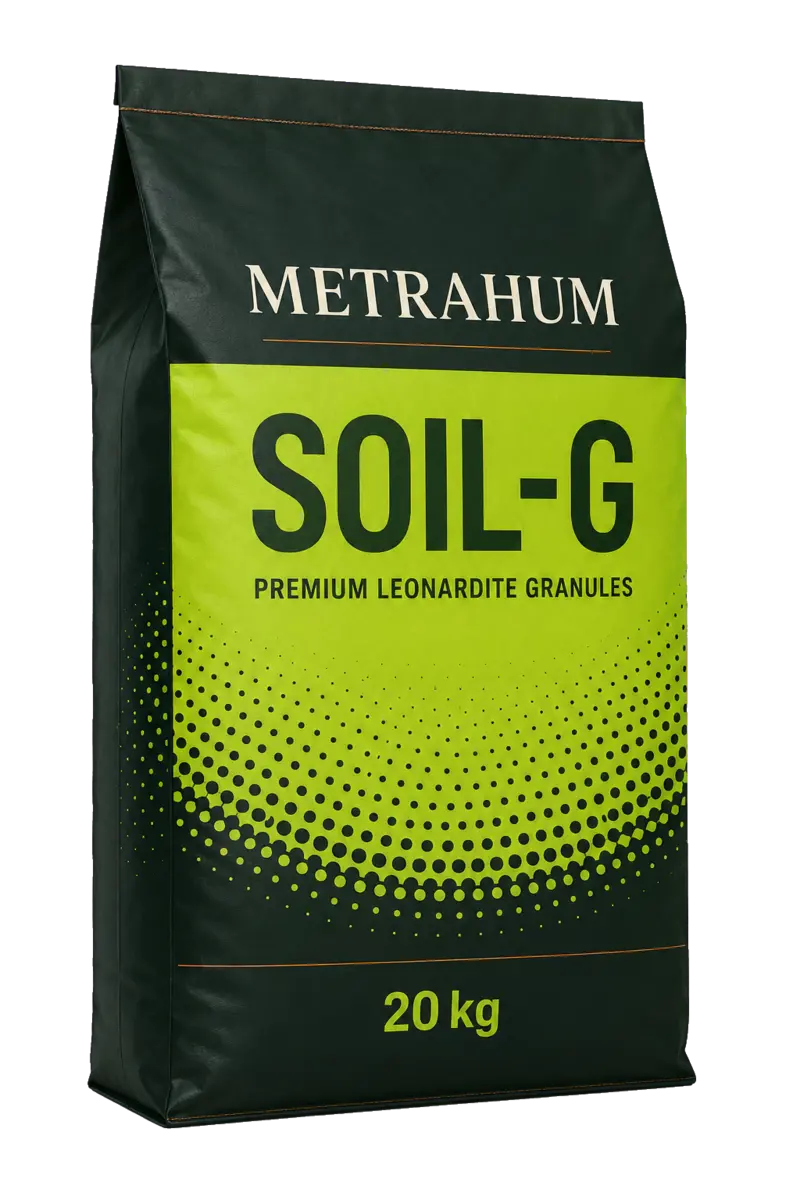
SOIL-G is MetraHum’s non-extracted 2–4 mm natural leonardite route for direct soil placement where low dust, flowability and controlled spreading are required. It is not positioned as an irrigation-soluble concentrate. Final use must be confirmed against the market-specific registered label, lot documentation, soil analysis, equipment validation and local technical guidance.
- Confirm whether the product is natural leonardite, leonardite powder or an extracted soluble humate.
- Match the lot-specific CoA to the signed specification, current TDS, SDS and registered label.
- Verify sieve fractions, fines, oversize, loose bulk density, moisture, flow and integrity by agreed methods.
- Calibrate discharge and cross-swath distribution with the actual lot and operating speed.
- Set final rate, timing, incorporation and placement from the registered label, soil analysis and local technical guidance.
- Retain a sealed sample and record method, operator, equipment settings, weather and release decision.
PRACTICAL ANSWERS
Frequently asked questions
Is granular leonardite water soluble?
Not by definition. Natural leonardite granules are non-extracted solids for direct soil placement. Do not confuse them with extracted water-soluble potassium-humate granules; verify the product identity and label.
Are granules always better than powder?
No. Granules often offer lower dust and more controllable mechanical spreading, while powder may fit processes designed for fine solids. The correct form depends on placement, equipment, handling controls and the registered use.
Is a 2–4 mm declaration enough for supplier approval?
No. Require the sieve method, percentage in each fraction, fines and oversize limits, sampling plan, bulk density, moisture, integrity and lot-specific CoA. Then verify field spreading with the actual material.
Can I use the same spreader setting for every granular product?
No. Discharge and spread pattern change with size distribution, density, shape, moisture, operator speed and machine settings. Calibrate each product and recheck after relevant changes.
How should SOIL-G be selected and applied?
Select it when a non-extracted natural 2–4 mm leonardite granule fits the soil-placement objective and the available spreading equipment. Final rate, timing and incorporation must follow the registered label, lot documents, soil analysis and local technical guidance.
Technical references
- Penn State Extension — Calibrating Your Fertilizer Spreader
- Iowa State University Extension — Dry granular fertilizer equipment considerations
- ISO 3944:2026 — Fertilizers: determination of loose bulk density
- ISO 5311:2026 — Fertilizers: determination of tapped bulk density
- European Union — Regulation (EU) 2019/1009 on fertilising products
This article provides product-selection and operating logic, not a legally binding application rate. Final use follows the registered label, batch documentation, water and soil analysis, and local technical guidance.