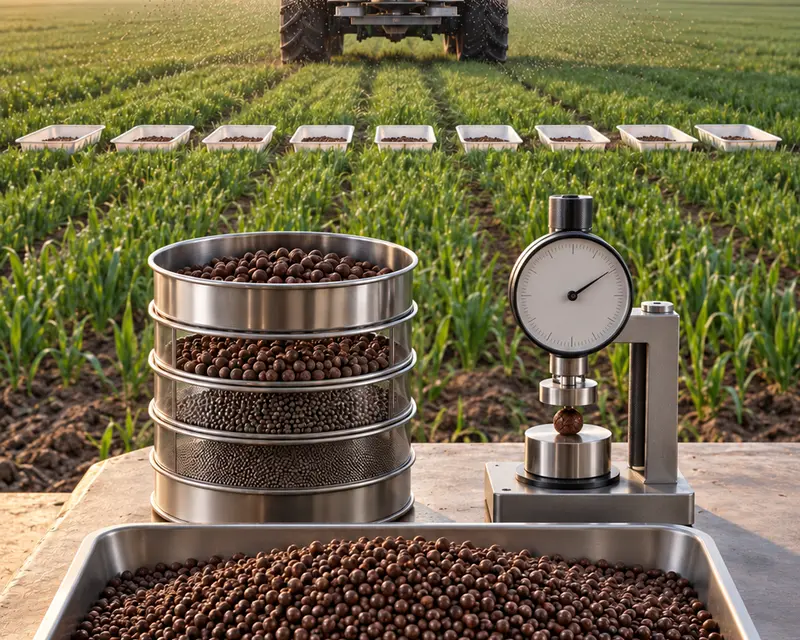
A dark, round granule is not proof of a uniform humate–NPK product. The finished lot must still deliver its registered nutrient grade, survive handling with limited breakage and pass through the intended spreader as a predictable material. Matrix granulation and surface coating can both be valid architectures, but they create different control points; colour alone cannot distinguish them or verify humate content.
Release therefore has two connected gates. The first asks whether a representative lot sample meets declared physical and chemical criteria. The second asks whether that exact lot, in the actual machine, produces the required rate and transverse pattern. Passing a laboratory sieve does not guarantee an even swath, and a visually even swath cannot replace nutrient analysis.
KEY TAKEAWAYS
- Declare whether humate is in the granule matrix or a surface coating before choosing tests.
- Use independent increments across the lot; one scoop from the top is not a representative sample.
- Recalibrate the actual spreader whenever lot size, density, strength or fines change materially.
1. Declare the architecture and release specification
Record the registered NPK grade, permitted claims, granule target, whether the humic component is incorporated or coated, and every method used for release. Set lot-specific limits only from the approved product specification and validated process; do not import a generic 2–4 mm, strength, moisture or humate percentage from another formula. For a coating route, include coating addition records and a validated continuity or distribution check. For a matrix route, control feed uniformity and granulation conditions. In both cases, verify the finished product—not only the premix.
2. Build a representative composite sample
Take independent increments across time and position during bagging, big-bag filling or transfer, using a written plan that matches lot size and packaging. Keep identity, time, location and sampler traceable. Combine and reduce the increments without preferentially losing fines or large particles, then retain sealed counter-samples. A single top-of-bag scoop can miss segregation, coating drift and the fines generated late in handling.
3. Measure size, density, moisture, strength and fines
Use a fixed sieve stack, sample mass, shaking time and reporting basis for particle-size distribution. Record the full distribution and fines, not only an average diameter. Measure loose bulk density with a defined filling procedure because hopper flow and mass delivered per volume can change with density. Determine moisture by the specified method and evaluate granule strength on a defined size class; crushing force rises with granule diameter, so unmatched sizes give misleading comparisons. Add an abrasion or handling simulation when transport dust is a release risk.
| Control | Keep constant | Decision use |
|---|---|---|
| Sieve distribution | Mass, sieves, time, basis | Flow, segregation and throw behaviour |
| Bulk density | Container and filling method | Volumetric feed and spread width |
| Crushing / abrasion | Size class and conditioning | Handling survival and fines risk |
| Nutrient analysis | Independent increments and method | Registered-grade conformity |
4. Separate nutrient uniformity from coating appearance
Analyse independent portions from the composite or a validated process-sampling sequence for the registered nutrients and any declared humic parameter using the named method and reporting basis. Compare variability as well as the lot mean. Visual colour checks can reveal obvious bare granules or agglomerates, but they do not quantify nutrient content, humic fractions or coating mass. If coating continuity is critical, use a validated tracer, mass-balance or imaging method tied to the process—not an improvised colour score.
5. Run a catch-tray test with the actual lot
Calibrate again when the product or lot changes. Place enough level collection trays perpendicular to travel to cover the full throw, prevent granule bounce, operate at the intended machine settings, disc speed, outlet, working speed, height and wind conditions, and make repeat passes consistently. Weigh each tray and plot the transverse pattern. Determine effective overlap and working width from the measured pattern, not from the maximum distance reached by a few granules. Separately collect and weigh output over a known area or time to verify the delivered mass rate.
6. Release, hold or reject with traceable evidence
Release only when identity and registered nutrient grade, representative sampling, physical limits, packaging condition, rate calibration and transverse pattern all pass the approved criteria. Hold the lot when evidence is incomplete, the sample is not representative or a method control fails. Reject or reprocess only under an authorised procedure when confirmed nonconformity affects composition, handling or field distribution. Preserve results, settings, weather, machine identity and retain sample so a complaint can be reconstructed.
PRACTICAL ANSWERS
Frequently asked questions
Is dark colour proof that every NPK granule is humate-coated?
No. Colour is only a visual screen. Verify the declared architecture through process records and a validated distribution or mass-balance method, then test the finished lot.
Why recalibrate if the NPK grade has not changed?
The same nutrient grade can have different size distribution, density, shape, strength and fines. These properties change hopper flow, throw distance and overlap.
Can one bag represent the whole production lot?
Usually not. Use a written incremental sampling plan across the lot and packaging sequence, then make a composite and retain counter-samples without losing particle fractions.
Does a uniform spread pattern prove the nutrient analysis?
No. The tray test verifies physical distribution. Registered nutrient conformity requires representative chemical analysis; both gates must pass.
Technical references
- University of Georgia Extension — Calibration of Dry Broadcast Fertilizer Applicators
- Penn State Extension — Calibrating Your Fertilizer Spreader
- Purdue Extension — Calibrating Fertilizer Spreaders
- DLG Technical Note 445 — Use of Mineral Fertilizer Spreaders
- University of Limerick — Compression Testing of Granular NPK Fertilizers
- University of Massachusetts — Rotary Spreader Calibration Procedures
This article provides product-selection and operating logic, not a legally binding application rate. Final use follows the registered label, batch documentation, water and soil analysis, and local technical guidance.