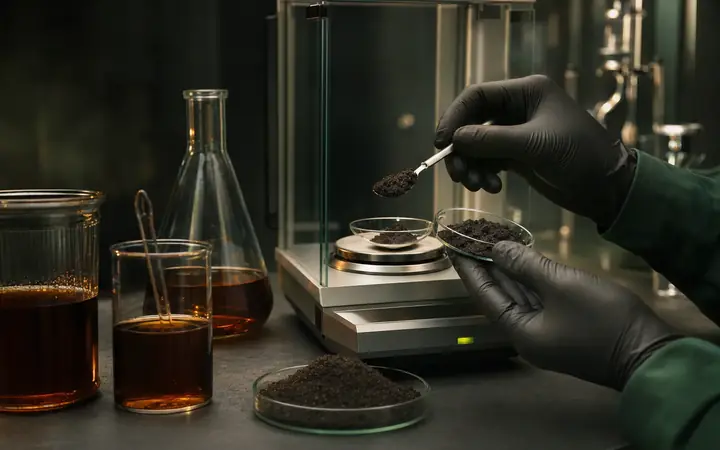
Two humic products can display similar—or dramatically different—percentages while the laboratory has measured different fractions, used different preparation steps or reported the result on a different basis. The number is therefore not a complete product identity. A defensible comparison begins with the exact analyte, method, sample state, reporting basis and lot reference.
ISO 19822 provides a standardized route for determining humic acids and hydrophobic fulvic acids in dry and liquid materials used in commercial fertilizers, soil amendments and geological deposits. It improves comparability when the scope is followed and reported correctly, but it does not make every market claim equivalent, replace representative sampling or prove agronomic performance.
KEY TAKEAWAYS
- Compare only results that identify the same analytical fraction, method, units and reporting basis.
- ISO 19822 reports operationally defined humic acid and hydrophobic fulvic acid; it should not be silently relabelled as every possible fulvic fraction.
- A lot CoA needs sample identity, method, basis and traceability; a generic specification sheet is not lot evidence.
- Final product use follows the registered label, batch documentation, water and soil analysis and local technical guidance—not the largest percentage on a certificate.
1. Why a humic percentage needs a definition
Humic substances are heterogeneous materials, not one pure molecule measured by a single universal assay. Analytical methods separate fractions through defined operations such as alkaline extraction, acid precipitation and resin separation. The result belongs to that procedure. Terms such as “total humic substances”, “humic acid”, “fulvic acid” and “hydrophobic fulvic acid” must therefore not be treated as automatic synonyms.
| CoA wording | Question to ask | Why it matters |
|---|---|---|
| Humic acid | Which extraction, precipitation and ash-correction method? | Different procedures can isolate different operational fractions. |
| Fulvic acid | Does the method specify hydrophobic fulvic acid or another fraction? | The same label may conceal unlike analytical definitions. |
| Total humic substances | Is it measured, calculated or the sum of named fractions? | A calculated total is not automatically a separate validated analyte. |
2. What ISO 19822 standardizes—and what it does not
The published ISO scope covers determination of humic acids and hydrophobic fulvic acids in dry and liquid materials. The validated method described in the Journal of AOAC International adapts alkaline extraction and acidification, separates the fulvic fraction on a non-ionic resin at acidic pH and determines fractions gravimetrically on an ash-free basis. The method name and edition should appear in the laboratory report; “ISO tested” without a result, matrix and basis is incomplete.
ISO 19822 is an analytical method, not a product certification, crop trial or compatibility test. It does not establish a universal dose, prove that a product will dissolve in a particular irrigation water, or replace the regulatory rules of the market where the product is sold.
3. Put as-received, dry-basis and ash-free results on the same map
An as-received result includes the moisture present in the delivered sample. A dry-basis result mathematically removes that moisture. If the dry-matter fraction is known and both values refer to the same analyte and method, dry-basis percentage equals as-received percentage divided by the dry-matter fraction; the reverse conversion multiplies by that fraction. The moisture method and sampling time still matter because hygroscopic products can change during handling.
Ash-free reporting addresses inorganic residue within the recovered fraction. It is not interchangeable with dry basis, and it should not be reconstructed from a marketing label without the method’s recovery and ash-correction data. Request the laboratory’s calculation basis and the underlying moisture and ash results rather than attempting an unsupported conversion.
| Reporting basis | What is included | Minimum companion data |
|---|---|---|
| As received | Moisture in the tested sample | Moisture method, sampling and test dates |
| Dry basis | Moisture mathematically excluded | Measured dry matter and conversion formula |
| Ash-free dry basis | Moisture and defined inorganic residue excluded | Method-specific recovery, ash determination and calculation |
4. Control the sample before interpreting the result
A precise method cannot repair a non-representative sample. Granular natural leonardite requires a plan that captures particle-size and moisture variation across the lot. Soluble powders require protection from moisture uptake and segregation. Liquid solutions require mixing before sampling; suspensions require a documented redispersion procedure and sampling location. Record container, lot, seal, date, sampler and storage conditions.
The laboratory should also confirm that the selected method is suitable for the matrix. A natural mineral-rich solid, an extracted dry concentrate, a clear alkaline solution and an acidic mineral suspension are not interchangeable test portions. Matrix, dilution and preparation belong in the analytical record.
5. Minimum fields for a decision-ready CoA
- Manufacturer, product identity, lot code, production date and sampled container or shipment.
- Laboratory, report number, sample receipt, preparation and test dates, plus authorization.
- Exact analyte, method identifier and edition, units and reporting basis.
- Moisture or dry matter, ash treatment and any calculation or conversion used.
- Specification limit beside the measured result, with uncertainty or quantification limit when relevant.
- Result status, deviations, retest rules, signature and traceable retained-sample reference.
6. Translate analysis into product-specific controls
For SOIL-G, humic analysis belongs beside representative sampling, moisture, ash or mineral residue and particle-size distribution. For WSG Core and WSP B2B, method and basis must be paired with dissolution and insoluble-residue protocols defined for the intended process. For K18, liquid density, dry matter and homogeneous sampling affect mass-based comparison. For BLACK-S, suspension redispersion and sampling location are essential before interpreting any concentration result.
Analytical content does not by itself select an agronomic program. Final use must follow the product’s registered label, lot-specific documentation, current water and soil analysis, equipment validation and qualified local technical guidance. Conduct compatibility work with the actual water, fertilizer partners and application system before tank mixing or injection.
PRACTICAL ANSWERS
Frequently asked questions
Does ISO 19822 measure total fulvic acid?
The standard’s stated analytes are humic acids and hydrophobic fulvic acids. Report that fraction by its method-defined name rather than silently generalizing it to every fulvic fraction.
Can results from two different methods be compared directly?
Not reliably. First align the analyte definition, method edition, matrix preparation, units, moisture basis and ash treatment. If they differ, report the results separately unless a validated conversion exists.
Is a dry-basis result always higher than an as-received result?
For the same analyte and method, removing non-zero moisture normally raises the numerical percentage. But the comparison is valid only when dry matter was measured correctly and the reports use the same fraction, units and calculation rules.
Does “100% water soluble” mean 100% humic acid?
No. Solubility is a physical test claim that depends on defined water, concentration, temperature, mixing, settling and filtration conditions. It is not the same measurement as humic-acid content.
How should a MetraHum product be selected after reading the CoA?
Use the CoA to confirm lot identity and agreed analytical controls, then select the product route through the registered label, batch documentation, water and soil analysis, application equipment and qualified local guidance. The CoA does not prescribe dose or compatibility.
Technical references
- ISO 19822:2018 — Determination of humic and hydrophobic fulvic acids
- Journal of AOAC International — Standardized humic and fulvic acid method
- International Humic Substances Society — Isolation of IHSS samples
- IHSS — Elemental composition, moisture and ash reporting
- California Department of Food and Agriculture — Fertilizing Materials Program
This article provides product-selection and operating logic, not a legally binding application rate. Final use follows the registered label, batch documentation, water and soil analysis, and local technical guidance.