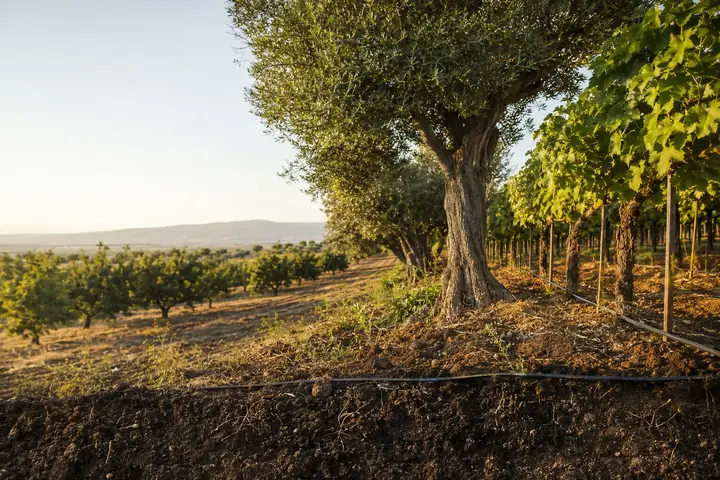
A high soil pH is a warning, not a complete diagnosis. Two soils can show the same pH while differing greatly in calcium-carbonate reserve, active lime, bicarbonate pressure, salinity, drainage and crop sensitivity. Those differences determine whether iron and other micronutrients remain accessible to roots—and whether an amendment can change the system at all.
Humic products can be evaluated as one component of a root-zone and nutrient-management program, but they are not a shortcut for neutralising the carbonate reserve of a calcareous field. The useful question is not “Will humic acid lower my pH?” It is “What is limiting the crop, and which product form can be placed safely in the diagnosed system?”
KEY TAKEAWAYS
- Alkaline describes pH; calcareous describes the presence of free calcium carbonate. They overlap, but they are not interchangeable.
- pH must be interpreted with total and active lime, irrigation-water bicarbonate, EC, drainage, soil moisture and crop or rootstock sensitivity.
- Iron chlorosis often reflects impaired availability or uptake rather than too little total iron in the soil.
- Humic inputs may support nutrient and root-zone management, but they do not replace crop diagnosis, suitable iron chemistry, irrigation correction or carbonate management.
1. Alkaline is not the same as calcareous
Soil pH measures the activity of hydrogen ions in a defined soil-water or soil-salt suspension. A calcareous soil contains free calcium carbonate, which creates a large buffering reserve. A non-calcareous soil may also be alkaline for other reasons, including sodium chemistry. Conversely, the practical behaviour of a calcareous soil depends on how much carbonate is present and how reactive the fine fraction is.
This is why attempting to lower the pH of an entire calcareous field can require impractically large acid equivalents. Local rhizosphere management may still be possible, but a short-term pH movement in irrigation water or a mixing tank must not be interpreted as permanent field-scale decalcification.
2. Build the diagnosis beyond pH
| Measurement | What it helps explain | Decision risk if omitted |
|---|---|---|
| pH and method | Soil reaction under the stated laboratory method | Comparing non-equivalent results |
| Total and active lime | Carbonate reserve and reactive fraction | Overestimating the effect of acidifying inputs |
| Water bicarbonate and alkalinity | Recurring buffer delivered with irrigation | Treating soil while reloading the cause |
| EC and sodium indices | Salt stress and possible sodicity | Confusing alkalinity with salinity or sodicity |
| Leaf/tissue analysis and symptom pattern | Whether the crop is actually nutrient limited | Treating visual yellowing without diagnosis |
3. Why iron chlorosis appears where total iron is high
At high pH, iron is rapidly converted into poorly soluble oxide and hydroxide forms. Calcium carbonate and bicarbonate strengthen the buffering environment, while wet, poorly aerated or cool root zones can intensify chlorosis in sensitive crops. The visible pattern is commonly interveinal yellowing of the youngest leaves, but similar symptoms and mixed deficiencies require confirmation rather than visual diagnosis alone.
Crop species, cultivar and rootstock matter. A program that works in a tolerant cereal cannot be transferred directly to grapevine, citrus, fruit trees, soybean or greenhouse vegetables. Irrigation scheduling, root health and the chemistry of the iron source can be as important as the amount applied.
4. What humic products can—and cannot—be asked to do
Humic substances contain functional groups capable of interacting with metals and may influence nutrient pools, root physiology and rhizosphere processes. Controlled studies have reported improved iron nutrition under specific humic-source, crop and experimental conditions. These findings justify evaluation, not a universal guarantee: humic materials differ by origin, extraction, composition and dose, and field response depends on soil, water and crop context.
A humic product should not be presented as a substitute for a diagnosed iron treatment, compatible chelate, drainage repair, irrigation-water management or selection of a tolerant rootstock. Nor should an acidic product be assumed to lower whole-field pH permanently. Its actual reaction, neutralising demand, compatibility and placement must be assessed in the real system.
5. Choose product form by placement—not by headline percentage
| Program need | MetraHum route to evaluate | Control point |
|---|---|---|
| Pre-plant or broad soil incorporation | SOIL-G natural leonardite granule | Soil analysis, spreader calibration, incorporation depth and local label |
| Soluble root-zone delivery through suitable irrigation | WSG Core water-soluble microgranule | Water bicarbonate, hardness, EC, dissolution, filtration and jar test |
| Metered liquid fertigation or root-zone dosing | K18 liquid potassium-humate platform | Actual batch specification, water chemistry, tank compatibility and crop protocol |
| High-solids soil suspension route | BLACK-S acidic ultramicronised-leonardite suspension | Do not infer field pH correction; verify agitation, filtration, compatibility and label |
6. A six-step decision workflow
- Map the symptom: crop, cultivar/rootstock, leaf age, spatial pattern, irrigation zone and recent weather.
- Test soil by depth for pH, EC, carbonate indicators, organic matter, texture and relevant extractable nutrients.
- Test irrigation water for pH, EC, bicarbonate/alkalinity, hardness and sodium-related indices.
- Confirm plant status with correctly timed tissue analysis and compare affected with healthy areas.
- Correct physical causes—drainage, compaction, over-irrigation and poor aeration—before expecting chemistry alone to solve the symptom.
- Run a limited, documented strip or block comparison using the registered label and local technical guidance before scaling.
7. Measure response without confusing symptom relief with soil correction
Record the treated and untreated comparison, application date, product batch, irrigation volume and water chemistry. Follow the same tagged plants or georeferenced zones. Short-term leaf colour, chlorophyll index and new growth can be useful, but they should be read with tissue analysis, yield or quality metrics and repeatable soil or water measurements.
If foliage becomes greener after a targeted nutrient intervention, that does not prove that total carbonate, active lime or irrigation-water alkalinity has changed. Keep the diagnosis layers separate: crop response, nutrient status, root-zone condition and the underlying carbonate system.
PRACTICAL ANSWERS
Frequently asked questions
Does humic acid lower the pH of calcareous soil?
Do not assume a durable field-scale reduction. Calcareous soils have a large carbonate buffer that neutralises acidity. Product reaction may change a tank solution or local microsite, but field pH response must be measured and interpreted against carbonate reserve and irrigation-water alkalinity.
Is high pH enough to diagnose iron chlorosis?
No. Use symptom position, crop and rootstock sensitivity, soil carbonate and moisture conditions, irrigation-water bicarbonate and correctly timed tissue analysis. Other deficiencies and root stresses can produce similar yellowing.
Which analysis matters most besides soil pH?
There is no single replacement number. Total and active lime, water bicarbonate/alkalinity, EC and sodium indices, soil moisture and drainage, and plant tissue results answer different parts of the diagnosis.
Can a humic product replace an iron chelate?
Not as a general rule. Humic substances and iron sources have different specifications and behaviours. If iron deficiency is confirmed, select the iron chemistry and application route for the measured pH, bicarbonate, crop and local registration; evaluate humic inputs as a separate supporting component.
How should a humic program be tested in a calcareous field?
Use a documented treated-versus-control strip or block with comparable soil and crop conditions. Follow the registered label and batch documents, record water and application data, and evaluate crop, tissue and root-zone indicators over an appropriate period before scaling.
Technical references
- Utah State University Extension — Managing Soil pH for Crop Production in Calcareous Soils
- USDA Agricultural Research Service — Physiology of Iron Deficiency Chlorosis
- FAO AGRIS — Effects of bicarbonate, nitrate and environmental factors on iron chlorosis
- Frontiers in Plant Science — Humic Acid Alleviates Fe Chlorosis in Graminaceous Plants
- Frontiers in Plant Science — Humic Substances Contribute to Plant Iron Nutrition
This article provides product-selection and operating logic, not a legally binding application rate. Final use follows the registered label, batch documentation, water and soil analysis, and local technical guidance.