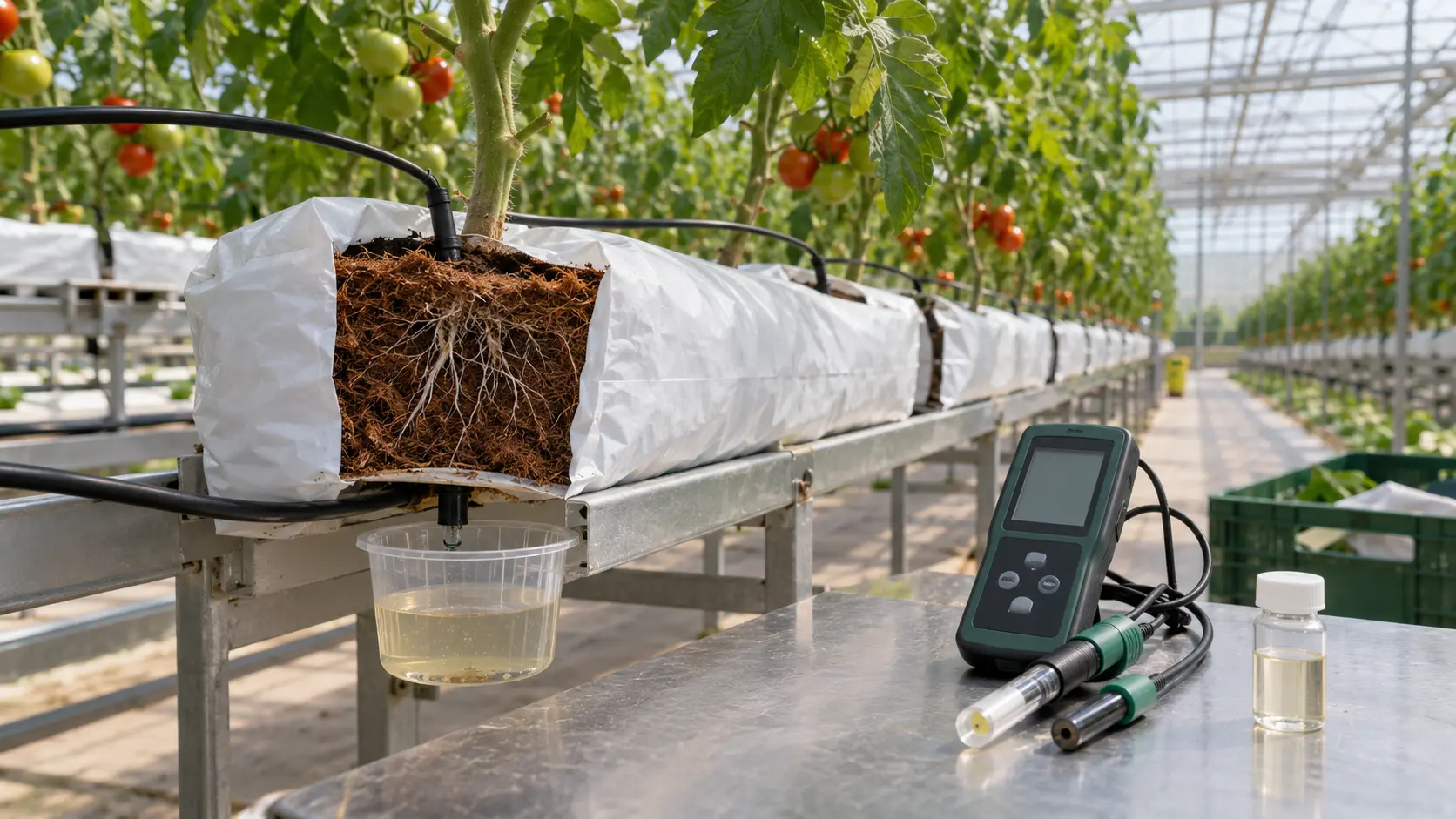
Cocopeat is a managed soilless root zone, not field soil in a bag. Its source, particle mix, washing and buffering history influence water holding, aeration and the salts presented to young roots. Adding a humic input therefore does not automatically mean that soil organic matter has been built or that a field-soil response will transfer to the greenhouse. The useful question is narrower: does this defined product improve a relevant crop endpoint without destabilising the nutrient solution or root-zone programme?
A publishable trial begins before treatment: document the substrate lot, crop, cultivar, irrigation water, nutrient recipe, dripper output and baseline feed-and-drain behaviour. Then screen the final solution, run a bounded crop-safety strip and compare replicated treated and untreated units under the same irrigation. WSG-HF 4:1 can enter this route only where its applicable label permits the intended use and the actual water, fertiliser and equipment combination passes local compatibility checks.
KEY TAKEAWAYS
- Characterise each cocopeat lot before assigning treatment effects.
- Measure source water, feed and drainage as separate samples at consistent times.
- Solution clarity and filter passage are compatibility gates, not proof of crop response.
- Scale only after a safe strip and a replicated trial with commercial endpoints.
1. Freeze the substrate baseline
Record the supplier, lot, fibre-to-pith balance, pre-wash and buffering declaration, bag volume and hydration method. Sample unused material and representative planted bags with one consistent extraction or leachate method. Measure pH and electrical conductivity with calibrated instruments and retain the raw values; do not compare numbers generated by different methods as though they were interchangeable. Where salinity or ion balance is a concern, send a representative sample to an accredited laboratory rather than inferring composition from EC alone.
2. Test the final fertigation solution
Use the same source water, fertiliser sequence, concentration procedure, temperature, filters and contact time planned for the greenhouse. Compare an untreated nutrient solution with the candidate solution in transparent vessels. Record initial and delayed pH and EC, visible haze, floc, sediment, filter residue and emitter flow. A clear jar is only a physical-compatibility result. It does not establish biological safety, efficacy or tank life beyond the observation window.
3. Monitor feed and drainage as a paired system
At fixed crop stages and times of day, collect source water, delivered feed and drainage from marked representative bags. Record irrigation volume, drainage volume or fraction, pH, EC, solution temperature and time since the irrigation event. Use the trend and the feed-to-drain difference to detect change; a single drainage reading cannot identify its cause. Keep instrument calibration, sampling location and collection method identical across treatments, and interpret targets through the crop programme and local advisory framework rather than a universal number.
4. Separate crop safety from efficacy
Start with a bounded strip containing the actual cultivar and crop stage. Compare untreated nutrient solution, the same programme plus the humic input, and—if needed—a carrier control. Watch for root browning, wilt, leaf-edge injury, emitter variability and unexpected pH or EC movement before expanding. Once safe, randomise replicated units across greenhouse position and keep substrate lot, plant density, nutrition and irrigation equal. Predefine one primary commercial endpoint such as marketable yield or grade distribution, supported by establishment uniformity, root observations and input records.
5. Write a bounded release decision
Report every result against the exact substrate lot, cultivar, water source, nutrient recipe, dripper, product lot, treatment window and sampling method. Include null and adverse results. A statistically different reading matters commercially only if the measurement is reliable, the effect size is useful and the crop-safety and system-compatibility gates also passed. The decision can release that defined programme, request another season or reject it; it cannot create a universal rate for all cocopeat systems.
PRACTICAL ANSWERS
Frequently asked questions
Does humic acid turn cocopeat into soil?
No. Cocopeat remains a managed soilless substrate. Treat the input as one component of a defined root-zone and fertigation programme.
Is drainage EC enough to prove an effect?
No. It is a management signal influenced by water, nutrients, irrigation and plant uptake. Interpret it as a time series beside feed measurements and crop endpoints.
Can a published experimental rate be used directly?
No. Research rates belong to their formulation and method. Follow the applicable label and validate the actual substrate, water, crop and equipment combination locally.
What should be the primary trial endpoint?
Choose one decision-relevant commercial endpoint before the trial, such as marketable yield or grade distribution. Use root and feed-and-drain observations to explain, not replace, that endpoint.
Technical references
- Peer-reviewed study: Humic acid addition, buffering and nutrient storage in cocopeat
- Oklahoma State University Extension: Soilless growing media and coconut coir
- Michigan State University Extension: pH and EC monitoring
- Purdue University Extension: Pour-through method for container media
This article provides product-selection and operating logic, not a legally binding application rate. Final use follows the registered label, batch documentation, water and soil analysis, and local technical guidance.