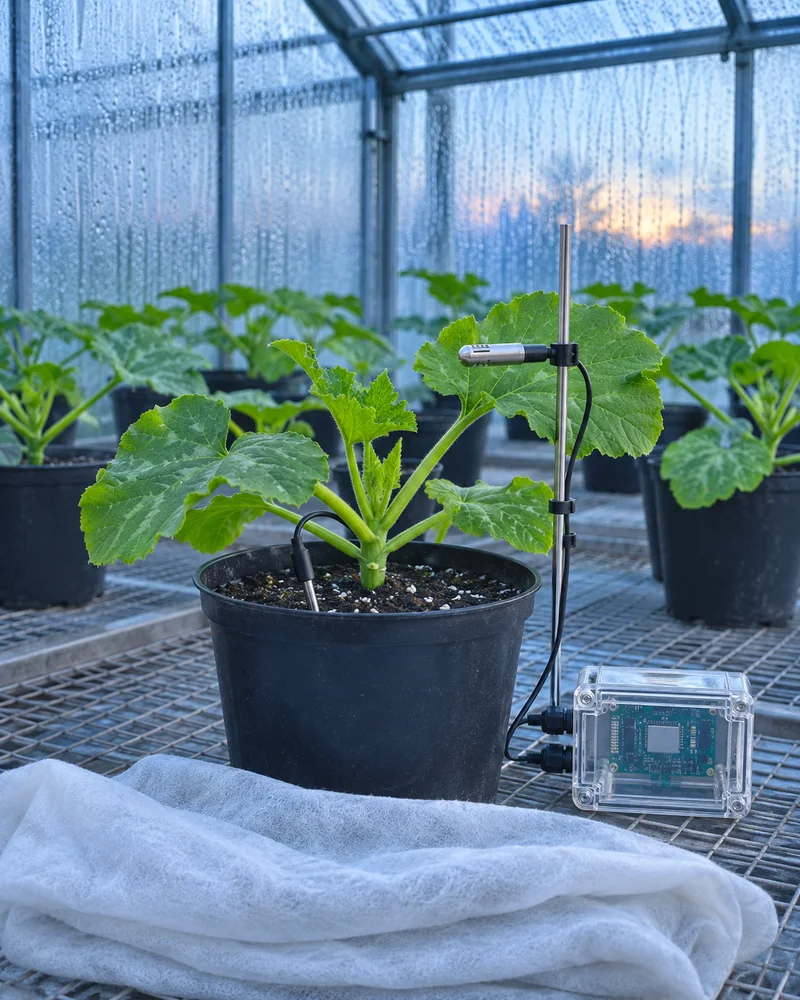
A humic treatment cannot be assigned a universal frost-protection temperature. Some experiments report improved plant responses to low temperature, but a response in a particular crop and formulation does not establish that a commercial programme prevents freezing injury. The practical question is narrower: does the exact programme improve a useful outcome under a measured, repeatable cold exposure?
KEY TAKEAWAYS
- Keep the existing frost-management plan in place during any trial.
- Record temperature, duration, crop stage and recovery, not only a morning photograph.
- Treat laboratory markers as supporting evidence; decide on plant survival, growth and marketable performance.
1. Define the cold event
Chilling describes injury or growth restriction at low temperatures without tissue freezing. Freezing involves ice formation and a different injury risk. The crop, cultivar, growth stage and previous acclimation matter. A weather-station minimum is not necessarily the temperature of a leaf or growing point; radiative cooling can make exposed tissues colder than the surrounding air.
Describe the event before judging a product: minimum temperature, time below the crop-relevant threshold, cooling and warming pattern, humidity, wind, substrate moisture and protection used. A short cool night and a prolonged freeze are different tests. Do not invent one threshold that applies to every crop.
2. Read the experimental boundary
A 2023 zucchini study examined humic materials at 5 °C and reported physiological and molecular responses. That is evidence about chilling in that experimental system, not a field frost rating. A 2026 oat study compared humic acid, zinc and application routes. A combined treatment response cannot be attributed to humic acid alone. Neither study certifies a MetraHum product or supplies a transferable application rate.
3. Compare the same crop under the same exposure
The following is a proposed practical workflow, not a validated standard. Define the crop, lot, stage, formulation, label-permitted route and decision rule before treatment. Use randomised, replicated treated and untreated units; include a carrier control where relevant. Equalise irrigation, nutrients, pot size, initial plant size and protection. When possible, add a comparable non-stressed reference to separate ordinary growth stimulation from a cold-specific response.
A greenhouse bench or climate chamber can be the true exposure unit. Several leaves on one plant are subsamples, not independent replicates. Avoid putting every treated plant beside a heater and every control beside the door. Record spatial blocks and use an analysis that respects the experimental unit.
4. Follow exposure and recovery together
Use checked sensors at canopy and root-zone height in representative positions. Synchronise clocks and save the complete temperature series. Record cover and heater operation. Score the same marked plants before the event and at preselected recovery times; delayed injury can be missed by an immediate photograph. Assess survival, damaged leaf area, new growth and time to a usable seedling or harvest stage.
Electrolyte leakage, chlorophyll fluorescence or laboratory stress markers can support interpretation when measured with a suitable method. They cannot replace marketable plant quality or yield. Preserve negative and inconclusive results, and repeat the comparison across relevant cold events before widening use.
5. Make a bounded product decision
Root/Stress Liquid and WSG Core are candidate programme routes only where the current market label permits the crop and application. Check the exact composition, lot documentation and compatibility first. A product-family name does not establish cold efficacy, a frost threshold or a dose. Where nutrients or other ingredients are present, the trial evaluates the complete programme unless separate controls isolate their contributions.
Retain heating, covers and other locally designed protection. Covers also require ventilation and crop-specific management. Do not reduce protection because a treatment looks promising. Accept a programme only for the tested crop, stage, formulation and exposure range; hold the decision when exposure or controls are inadequate, and stop expansion if crop injury or inconsistent outcomes appear.
PRACTICAL ANSWERS
Frequently asked questions
Can a humic product replace frost protection?
The cited evidence does not justify that replacement. Maintain the crop-specific protection plan and assess the product as an additional, locally tested programme.
Does a result at 5 °C prove frost tolerance?
No. A chilling experiment without tissue freezing cannot establish protection during freezing. Crop, stage, exposure duration and formulation remain part of the result.
Can the dose from a paper be used directly?
No. Verify the current product label, exact formulation and permitted route. Develop a small controlled trial with qualified agronomic support; do not transfer a research concentration to another product.
Technical references
- Li et al. (2023): zucchini seedlings under low-temperature stress
- Kutlu et al. (2026): humic acid, zinc and cold-stressed oat
- University of California IPM: Freezing and Frost
- Iowa State University: Frost Management in Vegetables
This article provides product-selection and operating logic, not a legally binding application rate. Final use follows the registered label, batch documentation, water and soil analysis, and local technical guidance.