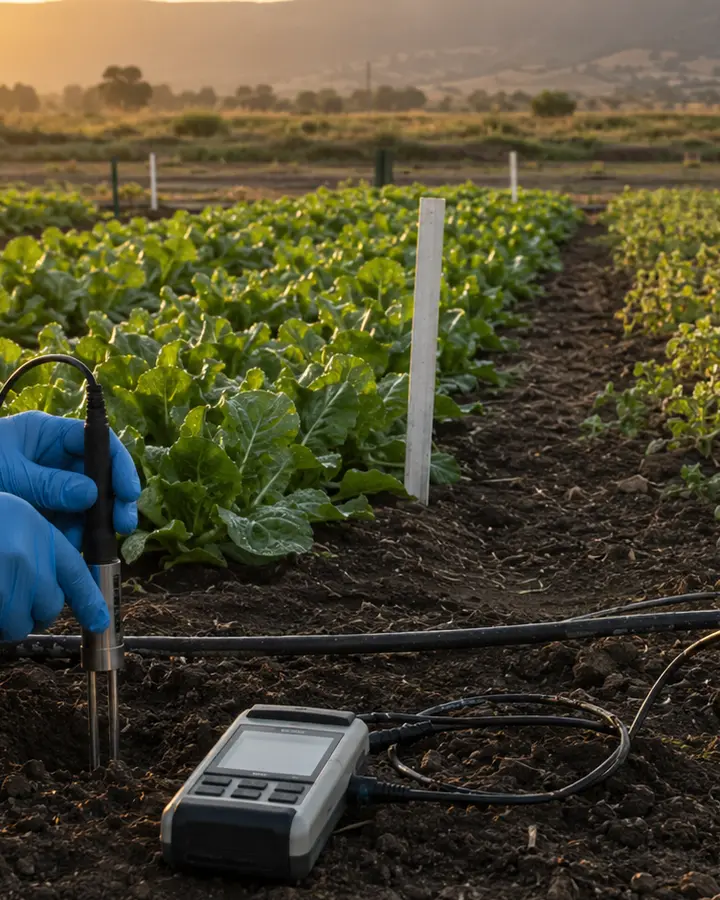
Search results often present humic products as if they could replace irrigation or guarantee a fixed percentage of water saving. That is the wrong starting point. Water demand is driven by climate, crop, growth stage, rooting depth, soil and irrigation uniformity. A humic input may influence root-zone conditions or plant response, but it does not remove the need to meet the crop’s water requirement.
A credible programme therefore asks a narrower question: under a defined crop, soil, water quality and irrigation regime, does the documented humic treatment improve an agronomically relevant response without hiding a yield or quality penalty? The answer requires a factorial comparison, measured water and a predetermined decision rule—not photographs alone.
KEY TAKEAWAYS
- Humic inputs complement water management; they are not a substitute for irrigation scheduling.
- The minimum useful design crosses irrigation level with treatment and includes the same untreated control at every water level.
- Record delivered water and root-zone moisture; scheduled minutes are not a water measurement.
- A greener canopy is not enough: yield, marketable quality and water productivity must agree with the physiological observations.
1. Define the claim before choosing measurements
Drought tolerance, water saving and water-use efficiency are not interchangeable claims. Tolerance concerns performance under water deficit. Water saving requires a measured reduction in applied water. Water productivity relates harvested output to water supplied or consumed. A treatment can improve one measure without improving the others.
Write the primary endpoint first. For example, the endpoint may be marketable yield under a defined deficit, or maintenance of establishment during a short stress window. Secondary observations such as canopy temperature, relative water status or chlorophyll can help explain the result, but they should not replace the endpoint that matters to the buyer.
2. Use a design that separates water from treatment
| Irrigation regime | Untreated control | Humic treatment | Question answered |
|---|---|---|---|
| Well-watered reference | Required | Required | Does treatment change performance without water stress? |
| Defined water deficit | Required | Required | Does treatment alter the response at the same water supply? |
3. Measure the water that actually reaches each plot
Start with a crop-water framework rather than an arbitrary reduction in irrigation minutes. Reference evapotranspiration, crop coefficient, rainfall and soil-water storage provide context for the planned regime. The final field record must still show actual irrigation volume by plot or treatment, because pressure, emitter flow and distribution uniformity can change the delivered dose.
Check emitters at more than one point along the lateral, verify meter readings and record rainfall. A single timer setting is not proof that treatments received equal water. If the field has a slope or soil-texture gradient, blocking and plot placement must account for it before treatment begins.
4. Follow the root zone, not only the weather station
Place moisture measurements at crop-relevant depths and use the same installation geometry in every treatment. Record before irrigation, after redistribution and at consistent intervals during the stress window. The useful outcome is a time series that shows how quickly water is depleted and whether all plots experienced the intended contrast.
Sensor values need field context. Note soil texture, bulk density or compaction, rooting depth and sensor calibration. A reading from one point should not be treated as the whole plot. Where instrumentation is limited, combine repeated sensor readings with gravimetric checks and documented sampling positions.
5. Connect early signals to harvest outcomes
Scientific studies report positive responses in some crop, soil and stress combinations, but results are not automatically transferable. Differences among humic materials, co-formulants, application routes, cultivars and stress timing matter. Include an untreated control and evaluate the actual MetraHum Root/Stress Liquid route under the intended water quality and delivery system rather than borrowing a rate from another study.
- Establishment: stand count, missing plants and uniformity at fixed dates.
- Stress response: canopy temperature, wilting score or plant-water measurement taken at the same time of day.
- Growth: biomass or canopy development measured without selecting only the best plants.
- Harvest: total and marketable yield, reject reasons and quality traits relevant to the crop.
6. Make the release decision from the whole dataset
Calculate water productivity with a clearly named numerator and denominator, such as marketable yield per measured irrigation volume. Report the absolute values for every treatment, not only a percentage difference. If rainfall or stored soil water materially contributes, state how it was handled. A higher ratio caused only by severe yield loss and a much smaller denominator is not automatically a better commercial outcome.
Release only the crop–site–product–irrigation combination that was tested. Preserve the protocol, lot identity, water analysis, weather record, emitter check, soil-moisture series and harvest data. A second season or site is especially valuable where drought intensity, soil or cultivar varies. The defensible conclusion may be positive, neutral or negative; all three are more useful than an unmeasured water-saving promise.
PRACTICAL ANSWERS
Frequently asked questions
Can humic acid replace irrigation during drought?
No. It may be evaluated as one component of a water-management programme, but crop water demand, irrigation scheduling and root-zone monitoring remain necessary.
What is the minimum control design?
Use untreated and treated plots at both a well-watered reference and a defined deficit, with replication and randomized placement.
Is irrigation duration enough to calculate water saving?
No. Verify flow, pressure and distribution, and record the actual volume delivered to each treatment together with rainfall.
Which crop measurements matter most?
Choose one commercial primary endpoint—usually marketable yield or establishment—and support it with consistent stress, growth and quality measurements.
Can a rate from a published study be copied directly?
No. Published results define evidence and candidate ranges, not a universal specification. Validate the actual product, crop, lot, water, soil and delivery system.
Technical references
- FAO Irrigation and Drainage Paper 56: Crop Evapotranspiration
- FAO CROPWAT: Crop water requirements and irrigation scheduling
- Scientific Reports: Humic acid and water-deficit stress in broccoli
- Frontiers in Plant Science: Humic substances from laboratory to field
- Scientific Reports: Foliar humic-acid response under drought
This article provides product-selection and operating logic, not a legally binding application rate. Final use follows the registered label, batch documentation, water and soil analysis, and local technical guidance.