Humic substances can be investigated through the leaf, but that does not make every leonardite or humate product a foliar formulation. Particle residue, incomplete dissolution, alkaline reaction, salts, co-formulants and source water can change nozzle flow, droplet behaviour and crop safety. The useful question is therefore not simply ‘Can humic acid be sprayed?’ but ‘Is this defined formulation, spray solution and crop window suitable and measurably safe?’
Research reports crop responses under particular formulations, concentrations, species and environments; it does not create a universal rate. A defensible commercial programme first screens the product and water, then proves physical delivery on the target canopy, runs a bounded crop-safety strip and finally tests an agronomic endpoint against the correct untreated control. WSG Core and K18 should enter this route only where the applicable label permits foliar use and local validation confirms compatibility.
KEY TAKEAWAYS
- Foliar suitability belongs to the final formulation, not to the words ‘humic acid’ alone.
- Separate solution stability, spray delivery, crop safety and efficacy into four release gates.
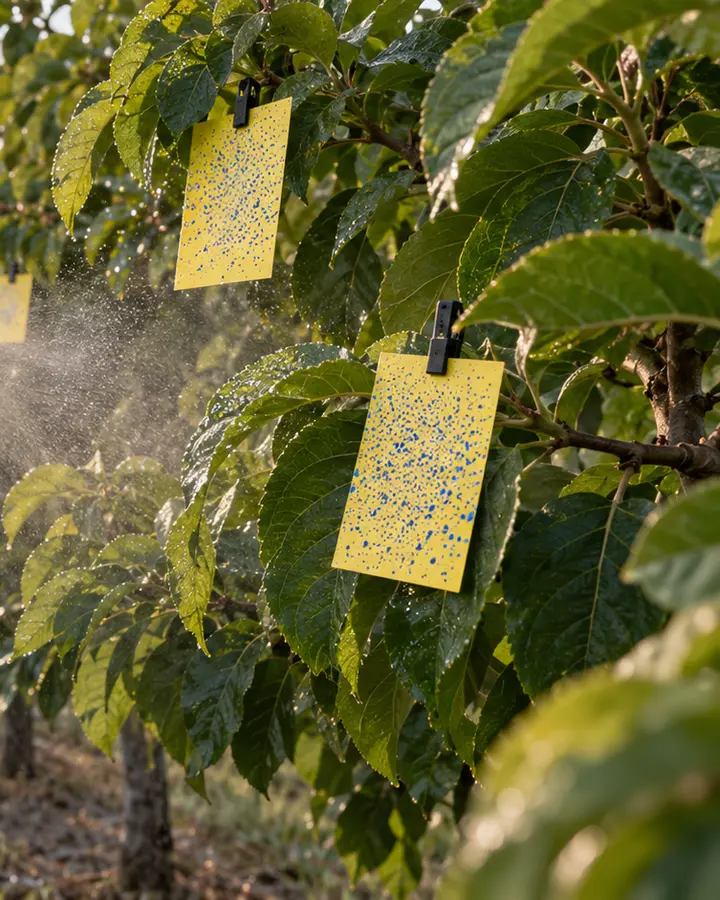
- Use water-sensitive cards and measured output; tank volume alone does not prove leaf coverage.
- Scale only after a symptom-free test strip and a replicated comparison with commercial endpoints.
1. Decide whether the product belongs on the leaf
Start with the registered label and the actual product specification. A natural leonardite granule or a suspension with measurable solids belongs to a soil or root-zone route, not automatically to a spray nozzle. A soluble humate may be a candidate, but only after checking dissolution, insoluble residue, pH, electrical conductivity and the complete set of nutrients and additives. Filterability does not by itself prove crop safety.
| Question | Release evidence | Stop condition |
|---|---|---|
| Is the route permitted? | Applicable label and market registration | Foliar use absent or excluded |
| Does the solution remain uniform? | Timed observation, residue and filter check | Sediment, floc, nozzle deposit or rapid pH drift |
| Is the crop safe? | Bounded strip with untreated comparison | Spotting, scorch, distortion or delayed growth |
2. Build the spray solution with the actual water
Analyse or at least screen the source water for pH, electrical conductivity, hardness, bicarbonate load and visible turbidity. Then prepare the complete intended recipe at field concentration and in the same addition order, agitation and holding time used by the sprayer. Record initial and final pH and EC, temperature, foam, sediment, colour change and filter residue. A stable product in deionized laboratory water can still fail in farm water.
Do not infer tank-mix safety from separate products. If fertilizers, micronutrients, adjuvants or crop-protection inputs are added, the complete mixture becomes a new test object. Replicate its order of addition and maximum realistic holding time in a jar test, but remember that a clear jar only passes physical screening; it does not establish label legality, biological compatibility or leaf safety.
3. Calibrate delivery before testing efficacy
The target is repeatable coverage without runoff, not the wettest possible canopy. Count or digitally assess droplet density and coverage on the cards using the same method for every plot. Keep operator and direction consistent or randomize them within the design. If coverage differs systematically between treated and control plots, the biological comparison is already confounded.
- Measure output from every representative nozzle and replace abnormal nozzles before the trial.
- Record nozzle type, pressure, travel speed, boom or lance position and applied volume per area.
- Place water-sensitive cards at upper, middle and lower canopy positions, including difficult leaf surfaces.
- Log wind, temperature, relative humidity, leaf wetness and rain-free interval for every pass.
4. Pass crop safety before expanding the treated area
Use a small, clearly mapped strip containing the intended crop, cultivar, growth stage and complete spray recipe. Include an untreated or carrier-water comparison exposed to the same pass and handling. Observe at fixed times after application and again after a relevant weather transition. Score visible spotting, marginal scorch, chlorosis, deformation, flower injury, delayed growth and any variety-specific symptom using a predefined scale.
Do not scale a strip that is merely symptom-free at the end of the spray pass. Some injury appears after drying, bright radiation, cool nights or repeated exposure. Define the observation window and stop rules in advance. If the formulation contains nutrients, judge cumulative salt load across the whole spray programme rather than one isolated pass.
5. Test efficacy separately from spray safety
A safe spray is not automatically an effective one. Use replicated, randomized blocks with the same water volume, nozzle, timing and passage for treated and carrier controls. Define one commercial primary endpoint—such as marketable yield, grade, fruit set or correction of a diagnosed short-term nutritional problem—and limit supporting measurements to those that explain it. Greener leaves, chlorophyll readings or photographs alone do not establish commercial value.
Where leaf or tissue analysis is used, sample before spraying or follow a validated residue-management protocol. Surface deposits from nutrient-containing sprays can distort the analytical result even after routine washing. Record sampling position, leaf age, time since application and laboratory preparation so an apparent nutrient increase is not mistaken for plant uptake.
6. Release only the tested spray programme
Approve the exact combination of product lot, crop, cultivar, growth stage, source water, complete tank recipe, nozzle, volume and weather window that passed all four gates. Preserve the label version, CoA, mixing record, calibration sheet, water-sensitive cards, weather log, safety scores, plot map and raw harvest data. A change in adjuvant, water source, partner product or spray interval creates a new combination that may require renewed screening.
The defensible outcome may be positive, neutral or negative. A neutral result prevents unnecessary cost; a negative result protects the crop; a repeatable positive result defines where scaling is justified. None should be converted into a universal claim about all humic acids. State the boundary of evidence clearly and keep root-zone or soil benefits separate from the leaf response measured in this trial.
PRACTICAL ANSWERS
Frequently asked questions
Can every humic-acid product be sprayed on leaves?
No. Foliar suitability depends on the registered label, final formulation, dissolution, residue, pH, salt and additive profile, source water, crop and spray system.
Does a clear jar test prove foliar safety?
No. It only screens physical compatibility. Label compliance, biological compatibility and crop safety require separate review and a bounded test strip.
Why use water-sensitive paper?
It shows where droplets reached and whether coverage varied through the canopy. It supports calibration but does not measure uptake or efficacy.
When should leaf samples be collected?
Preferably before a nutrient-containing spray. If sampling later is necessary, use a validated residue protocol and record leaf position, age and time since application.
Can a published foliar rate be copied directly?
No. Formulation, crop, cultivar, water, nozzle, climate and regulation differ. Follow the applicable label and validate the actual combination locally.
Technical references
- Journal of the Saudi Society of Agricultural Sciences: Review of humic foliar application
- Scientific Reports: Foliar humic-acid response under water stress
- Frontiers in Plant Science: Short-term root and foliar action of humic substances
- Penn State Extension: Foliar fertilization in vegetable production
- University of Florida IFAS: Plant tissue analysis and foliar-spray residues
This article provides product-selection and operating logic, not a legally binding application rate. Final use follows the registered label, batch documentation, water and soil analysis, and local technical guidance.