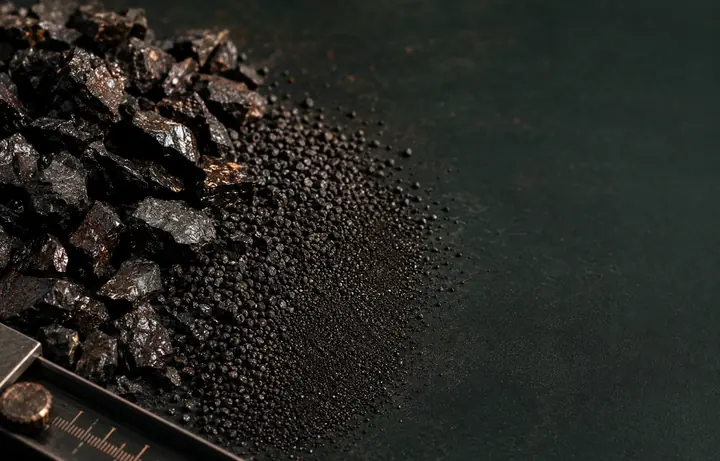
Humic acid, fulvic acid and potassium humate are often presented as interchangeable names. They are related, but they do not describe the same analytical fraction or the same product form. The practical difference becomes visible when a grower has to choose between soil incorporation, a dry soluble concentrate, a liquid dosing system or an acidic suspension.
The right comparison therefore starts with three questions: What exactly was measured? In which medium is the material soluble? How will the product reach the root zone? Percentage alone cannot answer these questions.
KEY TAKEAWAYS
- Humic acid and fulvic acid are operationally separated mainly by their solubility at different pH values.
- Potassium humate is a potassium salt of humic acids, commonly obtained through alkaline extraction of leonardite.
- Declared content must be read together with test method, dry-matter basis, solubility, ash, pH and potassium content.
- The best product is the one that matches the soil objective and the application infrastructure—not simply the highest number on a label.
1. One family, three different terms
Humic substances are a heterogeneous continuum rather than one pure molecule. In conventional fractionation, humic acid is the portion that dissolves under alkaline conditions but precipitates at very low pH. Fulvic acid remains soluble across both acidic and alkaline conditions. Humin remains insoluble. These are operational definitions: the result depends on the analytical separation procedure.
Potassium humate describes a product chemistry rather than a new natural fraction. It is formed when humic acids are converted into potassium salts—commonly by extracting leonardite with potassium hydroxide. This treatment can make the humic fraction suitable for soluble dry or liquid formulations, while also introducing potassium. Actual solubility still depends on extraction quality, mineral residue, formulation and water conditions.
| Term | Technical meaning | Typical practical role |
|---|---|---|
| Humic acid | Alkali-soluble fraction that precipitates under strongly acidic conditions | Soil-conditioning base and extracted humic formulations |
| Fulvic acid | Fraction remaining soluble over acidic and alkaline pH | Soluble formulations and nutrient-complexing programs |
| Potassium humate | Potassium salts of humic acids, usually from alkaline extraction | Water-soluble dry concentrates and liquid fertigation products |
2. Why the percentage on the label is not enough
Two products can display similar humic values and behave very differently in a tank or soil. The result may be reported on an as-is basis or on dry matter; one method may quantify precipitable humic acid while another reports a broader extracted fraction. Moisture, ash and non-humic organic matter can materially change the comparison.
For commercial product selection, the analytical method and basis should therefore appear beside the number. ISO 19822 specifies a procedure for determining humic and hydrophobic fulvic acids in dry and liquid fertilizer materials. It does not turn every product into an identical material; it creates a more comparable measurement framework.
- Analysis method and laboratory
- As-is or dry-matter basis
- Humic acid, fulvic acid and total organic matter reported separately
- Water solubility and insoluble residue
- pH, ash, moisture and K₂O
3. Choose the form through the application route
A granular soil conditioner and a soluble potassium humate are not rivals when they solve different parts of the program. Granular material is positioned physically in the soil and is selected for spreadability, particle integrity and contact with the managed soil layer. A soluble product must instead be judged by dissolution, residue, water quality and injection hardware.
The same logic applies to dry soluble and liquid potassium humates. A WSG concentrate reduces transported water and offers flexible stock preparation; a liquid concentrate can simplify dosing where pumps and tanks are already central to the operation. Neither format removes the need for filtration, compatibility testing or batch analysis.
| Field need | Suitable architecture | MetraHum route |
|---|---|---|
| Mechanical soil incorporation | Natural humic granule | SOIL-G |
| Dry soluble stock solution | Low-dust soluble microgranule | WSG Core |
| Direct liquid dosing | Liquid potassium humate concentrate | K18 |
| Acidic suspension step in soil programs | Fine acidic humic suspension | BLACK-S |
4. Five common selection mistakes
- Comparing percentages without checking the analytical method and basis.
- Assuming every black powder is fully water-soluble potassium humate.
- Selecting a soluble product without testing the actual irrigation water.
- Treating humic inputs as a replacement for complete crop nutrition.
- Using one product form for every crop, soil and delivery system.
5. The correct question is not “which is stronger?”
Humic acid, fulvic acid and potassium humate describe different analytical or formulation realities. Their value appears only when composition, solubility, water conditions, soil objective and delivery infrastructure are considered together.
For this reason, MetraHum organizes the portfolio by application route: SOIL-G for a granular soil foundation, WSG Core for soluble professional programs, K18 for liquid potassium-humate dosing and BLACK-S for defined suspension steps. Final analysis, dose and compatibility always follow the registered label and market-specific technical documentation.
PRACTICAL ANSWERS
Frequently asked questions
Are humic acid and fulvic acid the same?
No. They belong to the humic-substance continuum but are operationally separated by solubility. Humic acid precipitates under strongly acidic conditions; fulvic acid remains soluble.
Is potassium humate a humic acid?
Potassium humate is the potassium-salt form of humic acids, commonly produced by alkaline extraction. The exact product can contain different proportions of humic and fulvic fractions, potassium, water and mineral residue.
Which is better for drip irrigation?
A validated water-soluble potassium-humate product is generally the relevant architecture. The final choice between dry WSG and liquid concentrate depends on water quality, filtration, dosing equipment, logistics and the registered program.
Does a higher humic percentage always mean a better product?
No. Method, basis, solubility, ash, water compatibility, consistency and fit with the application route must be evaluated together.
Technical references
- ISO 19822:2018 — Determination of humic and hydrophobic fulvic acids
- International Humic Substances Society — Isolation of IHSS samples
- Humic Substances as a Versatile Intermediary (2023)
- Commercial Humates in Agriculture: Real Substance or Smoke and Mirrors? (2016)
This article provides product-selection and operating logic, not a legally binding application rate. Final use follows the registered label, batch documentation, water and soil analysis, and local technical guidance.