A soil amendment can bind a metal without removing it from the field. That distinction matters when a grower asks whether humic acid can make a potentially contaminated soil suitable for cropping. A lower laboratory extraction result, stronger roots and a greener canopy answer different questions; none alone demonstrates that the metal has left the site.
This guide proposes a decision record for growers, agronomists and technical buyers. It is not a remediation prescription or a clearance for food production. The question is deliberately narrow: what evidence is needed before accepting a claim about metal immobilization or removal?
KEY TAKEAWAYS
- Binding changes behaviour; removal requires a documented route out of the assessed soil.
- Match every result to its sample, method, units and decision endpoint.
- Product quality documents and site suitability are separate checks.
Binding is not a metal-removal balance
Immobilization means that a metal becomes less mobile under the conditions being assessed. The metal may still be present in the sampled soil. A removal claim needs an identified output, such as managed extracted material, and a defensible mass balance. Lower concentration after mixing in clean material can reflect dilution rather than removal.
Write the proposed claim before ordering tests. “Lower extractable cadmium under this method” is a different claim from “less cadmium in harvested grain” or “less cadmium remaining in the field.” Keeping those sentences separate prevents a favourable result from being stretched beyond its evidence.
Why the direction of the response can change
The Bavarian environmental agency explains that humic substances can retain metals, while acidification can increase their mobility. Binding therefore has to be evaluated with soil conditions, not treated as a permanent guarantee.
A 2022 rhizosphere study found that added dissolved organic matter could increase metal dissolution and uptake by Sedum alfredii. A separate 2024 alfalfa study showed differing soil-fraction and plant-compartment responses to humic and fulvic inputs. Neither experiment validates a MetraHum product.
For a practical assessment, name the target element and crop, record pH and water conditions, and ask whether the humic material remains associated with solids or contributes to dissolved organic matter. A result for one element or plant cannot be carried across to every metal, formulation and field.
Four questions, four different measurements
Use the following matrix as an original laboratory briefing template. Ask the laboratory to select methods suitable for the element, sample matrix and intended decision. A method-defined fraction is not a universal measure of availability. EPA guidance likewise treats oral bioavailability as an endpoint requiring validated methods; it is not interchangeable with plant uptake.
| Decision question | Evidence to request | Inference to avoid |
|---|---|---|
| How much is in this soil? | Defined total or pseudo-total digestion, dry-mass basis, depth and sampled area | A concentration alone proves removal |
| Did the extractable fraction change? | Same extraction protocol, units and sampling design before and after | Lower extraction guarantees safe harvest |
| Could metal move with water? | Soil solution or leachate with documented collection and filtration | Binding always stops transport |
| What is in the harvested part? | Crop-specific tissue sample; organ, preparation and fresh/dry basis recorded | A root or leaf test represents every edible organ |
Create the sampling record before adding anything
Map the field history first: imported fill, former storage areas, irrigation sources and suspected deposition zones. Maryland Extension recommends sampling suspect areas separately. Mixing a small affected zone with the rest of a field can hide the question that needs investigation.
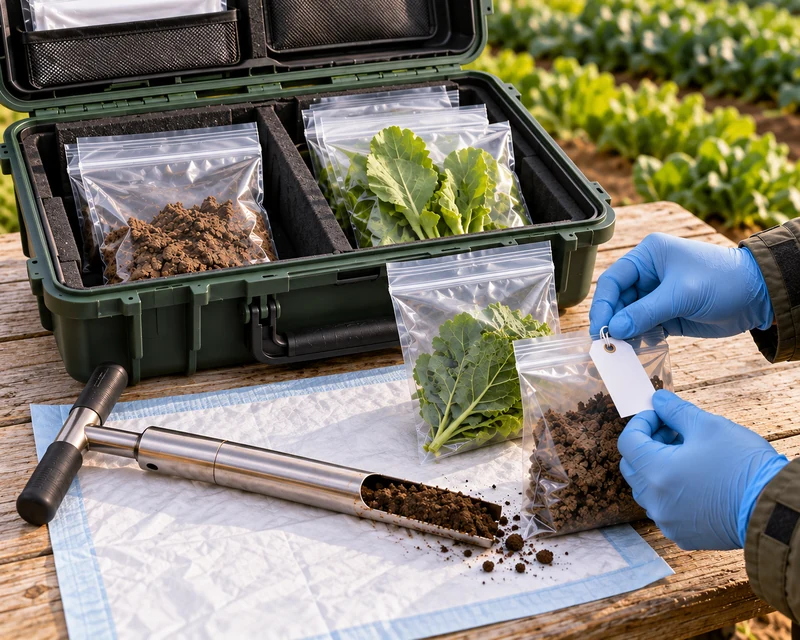
For each sample, record a unique identifier, location, depth, date, crop organ where relevant, preparation and custody. Agree on clean tools, containers, preservation and delivery with the laboratory. Keep soil and plant samples separate. Specify whether tissue preparation is intended to assess the crop itself or adhering particles; changing washing procedures between dates changes the comparison.
Request reporting limits, quality-control information and measurement uncertainty where available. “Below quantification” is not zero. Keep total and pseudo-total methods distinct, and never compare fresh-weight crop results directly with dry-weight results.
Check the input as well as the site
For SOIL-G, the relevant MetraHum route is a leonardite-based soil application. Request the current label, batch identity and appropriate lot-specific analytical documentation. Its presence in this guide is a route for technical enquiries, not evidence that SOIL-G removes metals or makes contaminated land suitable for food production. No product metal concentration is assumed here.
The purchasing file should connect the proposed input, actual batch and intended field. Ask what the document measures, whether its basis matches the supplied material and whether the site assessor has accepted it for the proposed use. A high humic fraction or a natural origin does not replace a contaminant check.
Decide with a comparison and a follow-up plan
If a qualified site assessment supports a trial, agree on an untreated comparison, sampling dates, target metals and decision criteria before applying the material. Keep the crop, irrigation and other inputs documented. Repeated samples should address the same locations and depths. Track soil chemistry alongside plant results so that a change in management is not mistaken for a product effect.
Use three outcomes in the decision record: continue observation when the agreed evidence is consistent; hold the decision when methods or samples are not comparable; escalate to the site specialist when dissolved or harvested-part concentrations increase or criteria are not met. Do not turn one favourable date into a permanent safety statement. The final record should state exactly what improved, what remained unchanged and what has not been demonstrated.
PRACTICAL ANSWERS
Frequently asked questions
Does humic acid destroy heavy metals?
No. Binding or changing chemical form does not destroy an element. A claim of removal needs a documented mass balance and managed output.
Is a lower extractable result enough?
It supports only the claim matched to that method and sampling design. It does not replace analysis of the relevant harvested tissue or demonstrate permanent immobilization.
Can a healthier crop confirm food suitability?
No. Growth observations and contaminant results are separate evidence. Use the relevant tissue analysis and the applicable local assessment process.
What should I request before considering SOIL-G?
Current label, batch identity and suitable lot analytical documents, followed by a site-specific assessment. This article provides no remediation dose, metal specification or decontamination guarantee for the product.
Technical references
- Bavarian LfU: soil retention and pollutant filtering
- Scientific Reports (2022): dissolved organic matter and rhizosphere metal mobilization
- Scientific Reports (2024): humic and fulvic inputs in molybdenum-contaminated soil with alfalfa
- University of Maryland Extension: lead in garden soils
- US EPA: soil bioavailability guidance and method limitations
This article provides product-selection and operating logic, not a legally binding application rate. Final use follows the registered label, batch documentation, water and soil analysis, and local technical guidance.