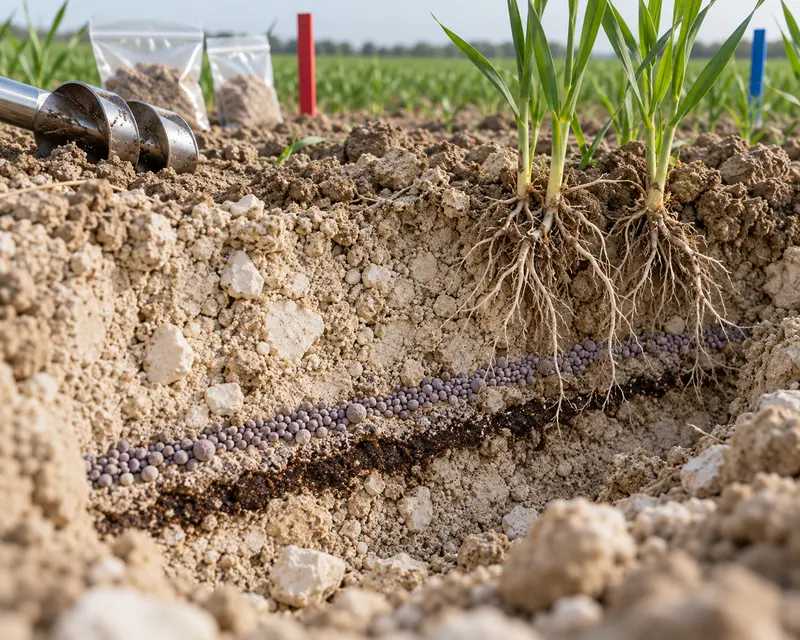
Humic inputs and phosphorus fertilizer can be evaluated in the same programme, but that does not mean a humic product supplies phosphorus or automatically reduces the fertilizer requirement. In calcareous soil, phosphorus reactions depend on pH, carbonate status, the fertilizer source, placement, moisture, time and the crop. The useful question is therefore not simply whether the two can be used together, but whether a defined humic treatment changes crop response under a fixed phosphorus programme.
A defensible answer starts before application: representative soil sampling, a locally calibrated phosphorus test, a complete nutrient budget and a factorial field comparison. The result must be read through crop uptake, yield and post-harvest soil phosphorus—not through one laboratory number or one visually greener plot.
KEY TAKEAWAYS
- Use a phosphorus test calibrated for the soil pH and region; do not convert Olsen-P and Bray-P with a universal factor.
- Count phosphorus only from declared phosphorus sources; a humic treatment is a separate factor unless its registered guarantee states P.
- Keep source, rate, placement, nitrogen, potassium, water and field operations equal when testing the humic effect.
1. Separate physical compatibility from agronomic response
Tank or stock-solution compatibility answers whether a specific recipe remains physically usable in a defined water and mixing sequence. It does not show that phosphorus availability or yield will improve. If products share a liquid system, first follow both current labels and safety data, then run the documented jar-test workflow with the actual water. Never improvise concentrated acid, phosphate and humate mixtures.
2. Choose a phosphorus test calibrated for the soil
Separate fields by soil texture, carbonate condition, management history and crop performance. Sample a consistent depth before treatment, avoiding fertilizer bands unless the protocol explicitly targets them. Record pH, carbonate or lime information, salinity where relevant, the extraction method, reporting unit and laboratory interpretation class. The same georeferenced zones and method must be used after harvest.
Olsen extraction is widely used for neutral-to-alkaline and calcareous soils, while Bray methods are commonly calibrated for acid conditions. The result is an agronomic index related to crop response under a local calibration, not a direct inventory of all soil phosphorus. Do not compare values from different extractants as if they were the same measurement, and do not apply a universal conversion factor.
3. Lock the phosphorus budget, source and placement
Build the phosphorus recommendation from the locally calibrated soil-test class, crop and yield objective, previous applications, manure or organic inputs and applicable regulation. Record the fertilizer analysis, formulation, amount, timing and placement. Banding and broadcasting can create different root-zone concentrations, so placement cannot change between treatments. Express the budget on one consistent P or phosphate basis and show every conversion.
Review the current local label and guaranteed analysis for the exact WSG Core or K18 lot. Count it as a humic treatment, not as phosphorus, unless the registered guarantee explicitly declares phosphorus. Do not reduce the standard P programme merely to create space for a product comparison: that would confound phosphorus rate with humic treatment and prevent a clean conclusion.
4. Run a phosphorus-by-humic factorial trial
Where agronomically and legally appropriate, use four randomized and replicated treatments: no P/no humic treatment, no P/with humic treatment, standard P/no humic treatment and standard P/with humic treatment. This 2 × 2 design separates the phosphorus main effect, the humic main effect and their interaction. If an untreated phosphorus control is not acceptable, retain at minimum matched standard-P plots with and without the humic treatment and state that the narrower design cannot estimate all effects.
Use the same cultivar, seed lot, planting date, plot geometry, P source and placement, nitrogen, potassium, irrigation and crop protection. Randomize within blocks that reflect field gradients and include enough independent replicates for the planned analysis. Guard rows and recorded machinery passes help prevent treatment carryover. A single strip or split field is demonstration evidence, not a replicated efficacy estimate.
| Treatment | What it isolates | Essential controls |
|---|---|---|
| No P / no humic | Baseline where permitted | Same N, K and field operations |
| No P / with humic | Humic effect without new P | Same product route and timing |
| Standard P / no humic | Farm phosphorus reference | Fixed source, rate and placement |
| Standard P / with humic | Added humic effect at standard P | Only humic factor changes |
5. Measure crop response and residual phosphorus
Choose one primary endpoint before the trial, normally marketable yield or another crop-specific production measure. Supporting measurements can include establishment, biomass at a defined stage, tissue phosphorus concentration and phosphorus uptake calculated from concentration and dry matter. Tissue concentration alone can be diluted by growth, so interpret it with biomass and the correct crop-stage reference.
After harvest, sample the same zones and depth with the same laboratory method. Separate band and inter-row sampling if placement created distinct microsites, and report that design. Residual Olsen-P can help track where extractable phosphorus changed, but one increase is not proof of greater crop uptake and one decrease may reflect uptake, fixation, movement or sampling variation. Close the interpretation with yield, uptake, weather, soil moisture and the complete P balance.
6. Make a product and economic decision
Compare the standard-P plots with and without the humic treatment using the pre-declared analysis. Calculate the added programme cost from a current delivered product quote, handling and application, then compare it with the observed change in marketable output. Do not transfer a positive result to another soil, crop, P source or placement without revalidation. Reject or repeat when the interaction is inconsistent, the physical route fails, the original P constraint is unchanged or the economic margin does not justify the programme.
PRACTICAL ANSWERS
Frequently asked questions
Can humic acid replace phosphorus fertilizer?
Not by default. Count phosphorus only from a registered phosphorus guarantee. Test any change in fertilizer rate as a separate, locally justified factor.
Is Olsen-P always the correct test for calcareous soil?
It is widely used in neutral-to-alkaline and calcareous conditions, but the useful method is the one locally calibrated for the soil and crop. Confirm with the laboratory or extension recommendation.
Does a jar test prove that the field programme will work?
No. It is a physical compatibility screen for one recipe and water. Agronomic response requires a controlled and replicated field comparison.
What is the minimum useful field comparison?
At minimum, compare matched standard-phosphorus plots with and without the humic treatment. A replicated 2 × 2 phosphorus-by-humic design is stronger because it can separate both main effects and their interaction.
Technical references
- FAO — Guidelines for Soil Description and Soil Phosphorus Evaluation
- Montana State University — Phosphorus: Soil Testing and Fertilizer Management
- University of Minnesota Extension — Phosphorus and Potassium for Sugarbeet
- University of Minnesota Extension — Phosphorus and Potassium for Corn
- Pedosphere — Movement of Phosphorus in a Calcareous Soil as Affected by Humic Acid
- Peer-reviewed review — Phosphorus Retention in Calcareous Soils
This article provides product-selection and operating logic, not a legally binding application rate. Final use follows the registered label, batch documentation, water and soil analysis, and local technical guidance.