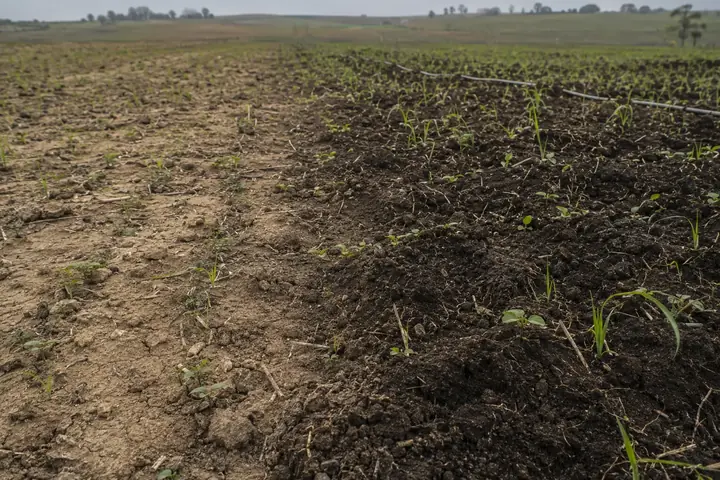
“Salty soil” is not a complete diagnosis. A root zone may contain too much soluble salt, too much exchangeable sodium, or both. These conditions can look similar in the field—poor emergence, weak growth, crusting and uneven wetting—but they require different correction logic.
Humic substances can be useful components of a soil and crop program, and controlled studies report physiological responses under salt stress. They do not, however, remove the need to measure the salt load, sodium hazard, drainage and irrigation water. The responsible question is not “Does humic acid cure salinity?” but “Which constraint was measured, what must be corrected first, and which product form fits the operating system?”
KEY TAKEAWAYS
- EC describes soluble-salt concentration; SAR and ESP describe sodium hazard. One value cannot replace the others.
- Saline soil and sodic soil require different primary correction strategies; drainage and water quality remain decisive.
- Humic inputs are supporting tools, not substitutes for calcium amendment where required, salt leaching or hydraulic correction.
- Select granular, soluble dry, liquid or suspension products by the measured objective and delivery system—not by headline percentage.
1. Salt-affected soil is not one diagnosis
Salinity is the concentration of soluble salts in the soil solution. It creates osmotic stress: water may be physically present, yet the plant needs more energy to take it up. Sodicity is a high proportion of sodium on the soil exchange complex relative to calcium and magnesium. It can disperse clay, weaken aggregates, seal the surface and reduce infiltration.
A saline-sodic soil carries both constraints. Its structure may appear temporarily stable while electrolyte concentration remains high. If salts are leached without first addressing exchangeable sodium, dispersion and infiltration problems can emerge. This is why a treatment based only on a surface EC reading can be incomplete.
| Screening class | ECe | SAR / ESP | Primary concern |
|---|---|---|---|
| Saline | > 4 dS/m | SAR < 13 and ESP < 15% | Osmotic stress and salt load |
| Sodic | < 4 dS/m | SAR > 13 or ESP > 15% | Clay dispersion and poor infiltration |
| Saline-sodic | > 4 dS/m | SAR > 13 or ESP > 15% | Combined salt and sodium hazard |
2. Read EC, SAR and ESP on the correct basis
For soil salinity, ECe normally means the electrical conductivity of the saturated-paste extract. A 1:2 or 1:5 soil-to-water test can also report conductivity, but its number is not directly interchangeable with ECe. The report must identify the preparation method, units and temperature correction.
SAR is calculated from sodium relative to calcium and magnesium in solution and indicates the tendency toward sodium-related permeability problems. ESP is the percentage of cation-exchange sites occupied by sodium. They are related but not identical measurements. pH is useful supporting information, not a substitute for either.
Sample by depth through the active root zone rather than compositing the whole profile into one number. Surface crusts can have much higher salt concentration than deeper layers, while a compacted or impermeable horizon may control whether leaching is possible.
3. Irrigation water can change the soil response
Evaluate irrigation-water EC and SAR together. Water with a high sodium ratio and low electrolyte concentration can be especially damaging to infiltration in susceptible clay soils. Bicarbonate, carbonate, chloride, boron and the seasonal variation of the source may also matter. A single analysis taken outside the irrigation season may not represent the operating condition.
Leaching works only when enough suitable water can move through the root zone and leave the profile. If drainage is absent, adding extra water may move salts sideways, raise a saline water table or create waterlogging. The hydraulic pathway must therefore be checked before calculating any leaching requirement.
4. What humic substances can—and cannot—be expected to do
Controlled experiments have reported that specific humic-acid treatments influenced photosynthesis, antioxidant activity, hormonal balance or ion-transport responses in plants exposed to defined salt stress. These findings support a potential biostimulant role, but they are product-, crop-, dose- and environment-specific. A result in perennial ryegrass or Arabidopsis cannot be converted directly into a universal field claim.
Humic material does not make sodium or chloride disappear from the root zone. On sodic soil, a calcium source may be required to replace sodium on exchange sites, followed by leaching under suitable drainage. On saline soil, the main salt balance still depends on incoming water, fertiliser salts, evapotranspiration, drainage and the leaching fraction. Humic products can be evaluated as supporting inputs inside that engineering and agronomic framework.
5. Match the product route to the measured objective
The four MetraHum forms solve different operating problems. They should not be treated as interchangeable sources of a headline humic percentage. Product choice begins with the delivery route, required solubility, equipment limits and the registered local use.
| Product | Operating fit | Critical check |
|---|---|---|
| SOIL-G | Mechanical or manual incorporation of a natural 2–4 mm leonardite granule during soil preparation | Spreader calibration, incorporation depth and soil-analysis objective |
| WSG Core | Pre-dissolved soluble microgranule for validated fertigation or root-zone programs | Real-water solubility, residue, filtration and batch documentation |
| K18 | Metered liquid potassium-humate route for compatible irrigation and root-zone systems | Water chemistry, alkaline reaction, potassium contribution and tank compatibility |
| BLACK-S | High-solids natural leonardite suspension for systems designed for agitation and suspension handling | Agitation, settling, particle profile, filtration and emitter compatibility |
6. A defensible field decision sequence
- Map visible variability and sample the active root zone by depth; keep problem and reference areas separate.
- Request soil ECe, pH, SAR or ESP, texture, cation-exchange capacity and relevant ions; analyze irrigation water for EC, SAR and locally important ions.
- Confirm drainage, infiltration and the destination of leached salts before adding water or amendments.
- Correct the primary hydraulic or sodium constraint with a locally engineered program; do not calculate a universal gypsum or leaching rate from this article.
- Choose the humic-product route from the measured objective and application hardware, then run a controlled strip or block trial.
- Re-measure at comparable depths and moisture conditions; track EC/SAR or ESP, infiltration, filter behaviour and crop response separately.
7. Manage a trend, not a single number
Salt-affected soil management is a mass-balance and soil-structure problem over time. Repeat sampling must use comparable locations, depths, methods and seasonal timing. A lower EC reading after rain does not by itself prove that the root-zone salt mass was removed; salts may have moved deeper or sideways.
The most useful humic program is therefore the one that has a defined baseline, a compatible product form, a documented operating procedure and a re-measurement plan. Final product selection and use must follow the registered label, batch documentation, actual water and soil analysis, and local technical guidance.
PRACTICAL ANSWERS
Frequently asked questions
Does humic acid remove salt from soil?
Not by itself. Salt removal requires water movement through the root zone and a drainage path. Humic products may be evaluated as supporting inputs, but they do not replace salt-balance and drainage management.
Can humic acid replace gypsum on sodic soil?
No universal substitution should be assumed. Where soil testing shows that exchangeable sodium must be displaced by calcium, the amendment type and rate must be engineered from SAR or ESP, amendment purity, water quality and drainage.
Is EC enough to diagnose sodic soil?
No. EC measures soluble-salt concentration. Sodium hazard requires SAR and/or ESP, interpreted with pH, texture, infiltration and water quality.
Which MetraHum product fits salt-affected soil?
There is no responsible answer without the diagnosis and delivery system. SOIL-G is a granular soil route; WSG Core and K18 are soluble routes subject to water and system validation; BLACK-S is a suspension route requiring suitable agitation and filtration.
How should progress be monitored?
Repeat comparable soil and water measurements and track ECe, SAR or ESP, infiltration, drainage, crop response and application-system behaviour. One visual observation or one EC reading is not enough.
Technical references
- USDA NRCS — Saline and Sodic Soil Management, Conservation Practice Standard 610 (2020)
- FAO — Water Quality Assessment: salinity, sodicity and soil permeability
- USDA NRCS — Testing and Interpreting Salt-Affected Soil (2024)
- Meng et al. — Humic acids enhance salt-stress tolerance in perennial ryegrass (2023)
- Khaleda et al. — Humic acid, HKT1 regulation and salinity stress in Arabidopsis (2017)
- Abbas et al. — Potassium and humic acid under salt stress in wheat (2022)
This article provides product-selection and operating logic, not a legally binding application rate. Final use follows the registered label, batch documentation, water and soil analysis, and local technical guidance.