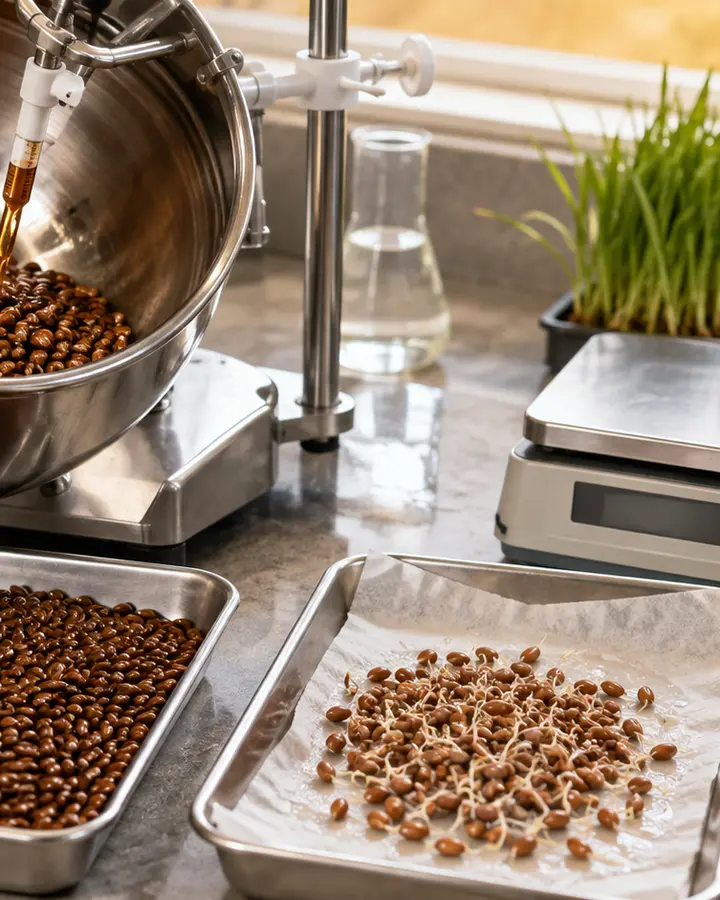
Search results often reduce humic-acid seed treatment to one promise and one universal dose. Seed technology is less forgiving. The same treatment can behave differently when the crop, seed lot, humic source, salt load, polymer, pesticide partner, application volume, drying process or storage period changes. A useful programme therefore starts with a comparison, not a claim.
The central question is not simply whether a seed looks darker after treatment. It is whether the process deposits the intended amount uniformly, preserves flow and plantability, avoids unacceptable injury, and maintains germination and vigour through the intended storage window. Those questions require an untreated control, a documented process and crop-appropriate seed tests.
KEY TAKEAWAYS
- Priming, film coating and pelleting are different processes and must not share one improvised protocol.
- There is no universal humic-acid rate for every crop, seed lot and coating system.
- Germination percentage alone can miss differences in emergence speed, seedling uniformity and storage potential; vigour adds another decision layer.
- A passed bench test is specific to the documented crop, seed lot, formulation, equipment settings, drying process and storage window.
1. First name the process: priming, coating or pelleting
| Process | What changes | Critical validation question |
|---|---|---|
| Seed priming | Controlled hydration starts early germination processes before redrying | Was hydration stopped and drying completed without losing storability? |
| Film coating | A thin layer carries active ingredients with limited size change | Is coverage uniform while flow, drying and germination remain acceptable? |
| Pelleting or encrusting | Fillers and binders change seed size, shape and mass | Does the new geometry plant accurately and still allow water and oxygen exchange? |
2. Replace the universal-dose question with a response-window test
Humic materials are not one chemically identical active ingredient. Their source, extraction, pH, electrical conductivity, potassium or sodium contribution, insoluble residue and co-formulants can differ. Seed lots also differ in age, initial vigour, seed-coat permeability and sensitivity. A rate transferred from another crop or another product is therefore not a specification.
Controlled research also shows that the response can be non-linear: a lower concentration may perform differently from higher concentrations in the same experiment. This does not create a transferable recommended rate. It shows why a crop- and lot-specific response window, bounded by the registered label and seed-safety review, is more defensible than assuming that more concentrate must be better.
3. Screen the complete coating recipe, not the humic ingredient alone
- Confirm that every pesticide, biological, micronutrient, polymer, colourant and humic component is permitted for the intended crop and market.
- Use the actual seed lot and final water source; record formulation lot, density, pH, electrical conductivity and total liquid applied per seed mass.
- Check mixing order and concentrate-to-concentrate contact. A physically smooth cup mixture does not prove chemical stability, microbial survival or seed safety.
- Measure wet tack, seed-to-seed adhesion, coverage, drying time, residual moisture, dust-off, flowability and bridging in the intended treater and planter path.
- Keep a carrier-only control when the polymer or solvent may influence germination; otherwise the source of any effect cannot be separated.
4. Build a comparison that can survive review
Start from one well-mixed seed lot and divide it randomly. At minimum, retain an untreated control and the final candidate recipe; add a carrier-only control and bounded candidate levels when they answer a specific formulation question. Keep replicate groups independent. Apply every treatment with the same equipment logic, seed mass, mixing time and environmental conditions.
Record the full batch history: seed identity and starting quality, formulation and component lots, actual application mass or volume, coating time, inlet and outlet condition, drying endpoint, mass gain and visual uniformity. Without this record, a good germination result cannot be reproduced and a poor result cannot be diagnosed.
5. Measure more than final germination percentage
| Decision layer | What to record | Why it matters |
|---|---|---|
| Coating quality | Dose recovery, mass gain, coverage variation, wet clumping, drying and dust-off | Shows whether the intended treatment physically reached the lot in a usable form |
| Germination | Normal and abnormal seedlings, dead or fresh ungerminated seed and final percentage under the applicable method | Detects unacceptable loss of viability or seedling normality |
| Vigour | Validated crop-specific indicator such as emergence rate, radicle emergence, conductivity or controlled deterioration where applicable | Adds information about field emergence, uniformity and storage potential that final germination may not reveal |
| Plantability and storage | Flow, bridging, singulation, residual moisture and repeat tests at defined storage checkpoints | Connects the laboratory result with the actual treating, storage and sowing workflow |
6. Define the storage window before declaring the treatment ready
A treatment that passes immediately after drying is not automatically validated for weeks or months of storage. Moisture redistribution, polymer ageing, salt concentration near the seed coat and interactions among active ingredients can change performance over time. Select storage checkpoints that represent the intended commercial workflow and repeat the relevant germination, vigour, moisture, flow and appearance tests.
Release criteria must be written before results are seen. Define which physical observations are unacceptable, which statistical comparison or internal tolerance will trigger investigation, who reviews deviations and what constitutes a new formulation that requires revalidation. Do not move a rate, recipe or storage claim to another crop or seed lot without documented bridging evidence.
7. Match the validation plan to the MetraHum product route
Seed Start Liquid is the direct coating and seedling-start route in the portfolio. Its commercial development logic is crop-specific seed safety, uniform low-volume application, compatibility with the complete coating package and a validated storage window—not an unqualified germination promise. WSG Core may support a soluble humate seed programme only where the registered label and the final process permit it; its dissolution and dose uniformity must be validated separately from a ready-to-use liquid route.
For field crops, the validation must extend to planter flow, singulation and emergence under representative seedbed conditions. For greenhouse seedlings, tray emergence, uniformity, root-system quality and transplant readiness may be more informative. In both routes, the current registered label, seed-company requirements and local technical guidance govern final use.
PRACTICAL ANSWERS
Frequently asked questions
Does humic acid always increase seed germination?
No. Published responses depend on crop, seed lot, humic material, concentration, treatment process and test conditions; higher concentration can also perform worse. Validate the final commercial recipe against an untreated control and do not convert one study into a universal claim.
What is the correct humic-acid dose for seed coating?
There is no responsible universal rate. Use only a rate permitted by the current crop- and market-specific label, then confirm coating quality, germination, vigour, plantability and storage with the actual seed lot and complete recipe.
Can humic coating be mixed with fungicides, insecticides or polymers?
Compatibility is formulation-specific. Every label must permit the intended combination, and the complete recipe must be checked for physical behaviour, active stability where relevant, coating quality and seed safety. A smooth-looking mixture alone is not a pass.
Is a germination test enough after coating?
Not always. Germination is essential, but vigour may reveal differences in emergence speed, uniformity and storage potential. Coating uniformity, drying, dust-off, flow and planter performance also answer questions that a germination test cannot.
How long can humic-treated seed be stored?
Only for the validated window stated by the responsible supplier or seed programme. Immediate post-treatment results do not establish long-term storage. Repeat relevant tests at checkpoints representing the intended commercial interval and conditions.
Technical references
- ISTA — International Rules for Seed Testing 2026
- ISTA Vigour Committee — Validated seed-vigour testing
- Cornell University — Seed Coating Technologies: Practical Guidance
- Agriculture — Modern Seed Technology: Seed Coating Delivery Systems
- Scientific Reports — Humic-acid seed priming and concentration response in lentil
- Scientific Reports — Humic- and silicic-acid priming under salinity
This article provides product-selection and operating logic, not a legally binding application rate. Final use follows the registered label, batch documentation, water and soil analysis, and local technical guidance.