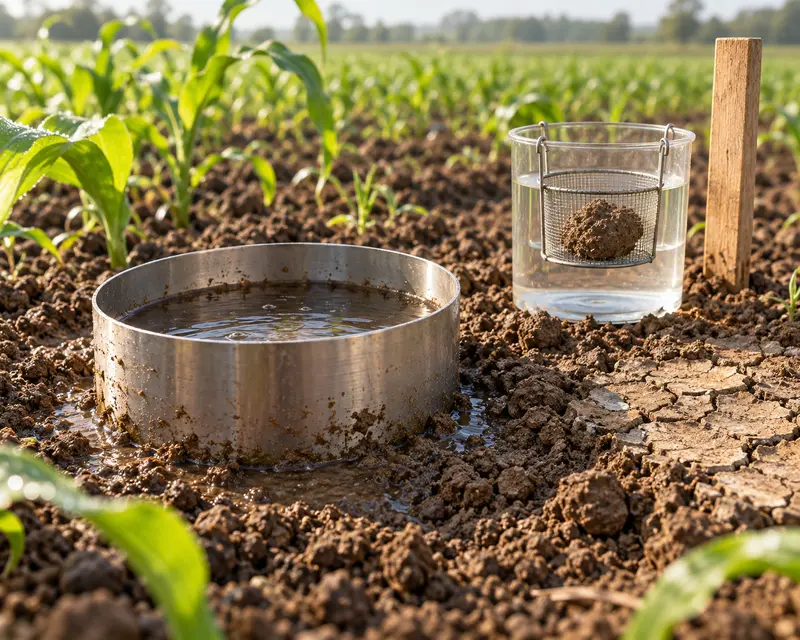
“Improves soil structure” is not a single measurable claim. Structure describes how particles and pores are arranged, while the field result appears through aggregate stability, crusting, infiltration, aeration, root access and traffic response. A humic input may be worth testing, but colour, softness after tillage or one fast infiltration reading cannot establish a structural change.
A defensible trial starts with comparable management zones and an untreated control, then repeats the same physical methods at defined moisture and timing. The objective is not to force every indicator upward; it is to decide whether a consistent, agronomically useful change survives rainfall, wetting–drying cycles and normal field operations.
KEY TAKEAWAYS
- Treat aggregate stability, slaking, infiltration and bulk density as related but non-interchangeable endpoints.
- Match texture, depth, initial moisture, residue, tillage and traffic before comparing treatments.
- Qualify a programme only when repeated physical measurements and field function point in the same direction.
1. Define the physical endpoints before the trial
Choose one primary endpoint and a compact supporting panel. Water-stable aggregates or a standardized aggregate-stability result can be primary when crusting and erosion are the problem. Infiltration can be primary when ponding or runoff is the operational constraint. Slake observations, bulk density, surface-crust thickness, emergence and root-zone observations support the interpretation but should not be collapsed into an invented single score.
2. Map the baseline and structural confounders
Separate management zones by texture, slope, drainage, previous crop and traffic history. At fixed coordinates and depths, record residue cover, tillage, wheel tracks, irrigation or rainfall, initial water content and the time since wetting. Do not place the treated strip on the better-drained shoulder and the control in a compacted headland. The same machinery passes, cultivation depth, crop, irrigation and residue management must apply to both.
3. Measure aggregate stability and slaking consistently
ISO 10930 defines laboratory treatments for the stability of selected soil aggregates under water action. A field slake test is a useful visual screen, but it is not the same measurement and should not be presented as an ISO result. For every date, keep sampling depth, aggregate-size class, drying or preconditioning, water quality, immersion time, sieve or basket and scoring method unchanged. Collect enough independent field samples to represent each plot; repeated fragments from one clod are not field replication.
4. Pair infiltration with bulk density and crust observations
Infiltration varies with initial moisture, cracks, macropores, ring insertion, water depth and operator timing. Use the same ring size, insertion depth, water head, pre-wetting rule, reading intervals and stopping rule in paired locations. Record both the first increment and the later near-steady behaviour when the protocol permits. Pair the result with intact-core bulk density and a documented surface-crust observation, because a fast path through one crack does not describe the whole plot.
| Endpoint | What to hold constant | Interpretation limit |
|---|---|---|
| Aggregate stability | Depth, size, conditioning, water, method | Method-specific; not directly interchangeable |
| Infiltration | Initial moisture, ring, head, timing | Sensitive to cracks and spatial variability |
| Bulk density | Core volume, depth, drying and stones | Compare within the same texture and horizon |
5. Run a replicated, treatment-only comparison
Randomize and replicate untreated and label-compliant SOIL-G treatments within each uniform block. Review the exact lot analysis, current local label, permitted crop, route and safety instructions; do not invent a universal dose. Keep soil operations, nutrients, seed, irrigation, residues and traffic equal. The experimental unit is the independently treated plot, not each ring or clod measured inside it. Predeclare the primary endpoint, measurement dates and analysis before seeing results.
6. Repeat after weather and make a bounded decision
Measure before treatment, after a defined establishment interval and again after meaningful wetting–drying or rainfall events; for a production decision, include the crop cycle where practical. A credible response is a treatment difference that is larger than plot variation, repeats in the same direction and aligns with field function such as less crusting, more uniform emergence or reduced ponding. Do not transfer it to another texture, tillage system, climate or application route without new validation.
PRACTICAL ANSWERS
Frequently asked questions
Does humic acid always improve soil structure?
No. Response depends on soil, product, management, weather and method. Use an untreated, replicated comparison and predefined physical endpoints.
Is a slake test the same as aggregate-stability analysis?
No. It is a useful visual field screen. A laboratory or standardized method controls aggregate size, conditioning, water action and calculation more tightly; report each by its actual method.
Why can infiltration results vary so much?
Initial water content, cracks, macropores, texture, crusts, ring placement and water head all matter. Pair locations and repeat under the same protocol rather than comparing isolated readings.
How soon should soil-structure measurements be repeated?
Use a predeclared schedule: baseline, a defined post-treatment interval and meaningful wetting–drying or rainfall events. A production claim generally needs evidence across the relevant crop cycle, not only hours after application.
Technical references
- ISO 10930:2012 — Soil quality: aggregate stability under water action
- USDA NRCS — Soil Health Assessment
- USDA NRCS — Cropland In-Field Soil Health Assessment Guide
- USDA NRCS — Soil Infiltration: Guides for Educators
- USDA NRCS — Soil Bulk Density, Moisture and Aeration
- INRAE — Protocol for measuring soil structural stability
- Solid Earth — Humic acid, aggregate stability and a crusting problem soil
This article provides product-selection and operating logic, not a legally binding application rate. Final use follows the registered label, batch documentation, water and soil analysis, and local technical guidance.