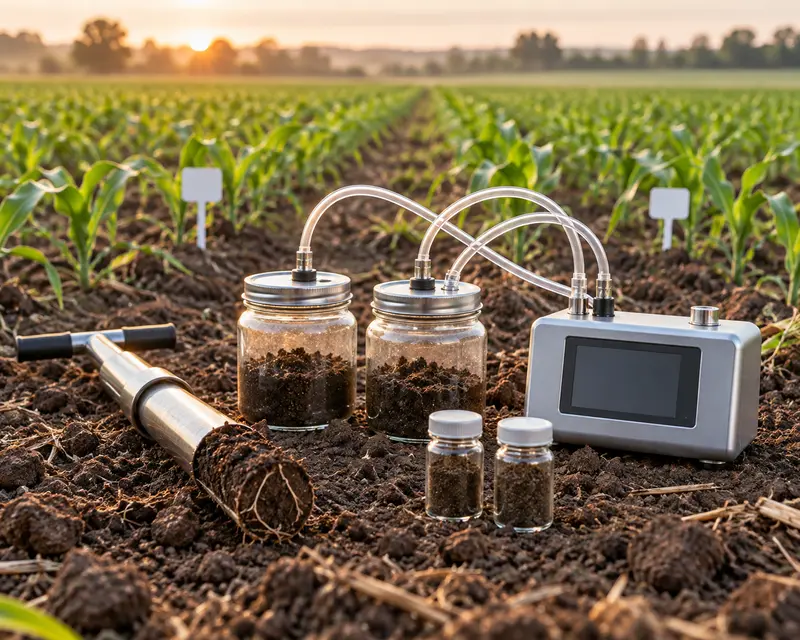
A higher carbon-dioxide reading after a soil input does not by itself prove a larger, healthier or more useful microbial community. Respiration is a rate: it changes with water content, temperature, fresh roots, residues, carbonate chemistry and the time between sampling and measurement. Microbial biomass is a stock, while enzyme activity and community composition answer still other questions. The indicators are related, but they are not interchangeable.
A defensible SOIL-G evaluation therefore uses a matched untreated control, a declared primary biological endpoint and repeated measurements under standardized conditions. It also checks whether any biological shift aligns with crop performance and soil function. The purpose is not to force every indicator upward, but to determine whether an exact, label-compliant lot creates a repeatable and agronomically relevant response.
KEY TAKEAWAYS
- Respiration measures metabolic activity; microbial biomass estimates a living carbon or nitrogen pool.
- Standardize moisture, temperature, depth, root handling and pre-incubation before comparing treatments.
- Accept a biological claim only when replicated indicators and agronomic function support the same conclusion.
1. Separate activity, biomass and community structure
Basal respiration measures carbon dioxide production or oxygen consumption without adding an easy substrate. Substrate-induced respiration estimates the response of an activated fraction after a defined substrate addition. Fumigation–extraction estimates microbial biomass carbon or nitrogen from the difference between treated and untreated extracts using a stated conversion. Enzyme assays reflect potential activity for a chosen reaction under the assay conditions. DNA-based profiles describe composition or relative abundance, not total living biomass or field function.
2. Control sampling and laboratory conditions
Divide the site into uniform management blocks using texture, slope, crop history, residue, traffic and irrigation. Sample treated and control plots at the same depth, distance from the crop row and time of day. Record recent rainfall or irrigation, soil temperature and gravimetric water content. Decide in advance whether the method includes the rhizosphere, excludes visible roots or samples between rows; then use the same rule everywhere. Keep samples cool and aerated as the method requires, avoid freezing unless validated, and fix the holding time.
For laboratory respiration, report fresh- or dry-mass basis, water adjustment, incubation temperature, pre-incubation, vessel headspace, duration and whether CO₂ or O₂ was measured. Calcareous soil can contribute inorganic CO₂ under some conditions, while intact roots add autotrophic respiration in field chambers. These sources must be managed or acknowledged rather than attributed automatically to microorganisms.
3. Select a compact, interpretable indicator panel
Choose one primary endpoint before the trial. Microbial biomass carbon is suitable when the question concerns the size of the living pool; basal respiration is suitable when the question concerns short-term metabolic activity. Add one supporting biological indicator and at least one agronomic endpoint such as emergence, root mass, nutrient uptake, marketable yield or a relevant soil function. Avoid testing many enzymes and reporting only the favourable result.
| Indicator | What it answers | Main control |
|---|---|---|
| Basal respiration | Current metabolic rate | Moisture, temperature, roots, incubation |
| Microbial biomass C or N | Size of the living microbial pool | Extraction method, conversion and soil basis |
| Selected enzyme activity | Potential for one reaction under assay conditions | Substrate, pH, temperature and units |
4. Build a replicated, treatment-only field comparison
Within each uniform block, randomize replicated untreated plots and plots receiving the exact SOIL-G lot according to the current local label. Review the lot analysis, permitted crop, route and safety instructions; do not infer a universal rate or microbial effect. Keep crop, seed, nutrients, irrigation, tillage, residue and traffic equal. The experimental unit is the independently treated plot, not each jar, extraction or analytical replicate produced from one plot.
Measure baseline before application, then sample at predeclared times that can distinguish a short pulse from a sustained response. Repeat after comparable moisture conditions or normalize the laboratory incubation as the method requires. Analyse treatment effects at plot level and report uncertainty, non-significant results and departures from the plan. A temporary respiration spike without a biomass or agronomic response should be described as a short-lived activity change, not as proven soil improvement.
5. Interpret biological and agronomic evidence together
A useful decision matrix asks four questions: Was the primary biological endpoint repeatable across independent plots? Was the direction consistent over more than one sampling time? Did the supporting indicator agree rather than contradict it? Did the change coincide with a relevant soil or crop outcome without a management confounder? Release the programme for broader local validation only when the evidence chain is coherent. Hold when sampling or laboratory controls failed, and reject the claim—not necessarily the product—when the planned endpoints do not support it.
PRACTICAL ANSWERS
Frequently asked questions
Is more soil respiration always better?
No. It may reflect active decomposition, fresh roots, favourable moisture or a short carbon pulse; it can also mean faster carbon loss. Interpret it with biomass, moisture, temperature, soil carbon and an agronomic endpoint.
Are microbial biomass and microbial counts the same?
No. Biomass estimates the size of a living pool by a defined method. Plate counts recover only organisms that grow under the selected culture conditions, and DNA abundance has different limits.
Can a home CO2 kit prove a humic product effect?
It can screen relative activity only if sampling, soil mass, moisture, temperature, incubation and blanks are controlled. Product qualification still needs independent field replication, a validated method and supporting endpoints.
How soon should soil biology be measured after application?
There is no universal interval. Predeclare a baseline, an early time point that can capture a pulse and later points that test persistence, using crop stage, weather, the product route and the validated laboratory method.
Technical references
- ISO 16072 — Soil quality: laboratory methods for microbial respiration
- ISO 14240-2 — Soil microbial biomass by fumigation-extraction
- USDA NRCS — Soil Health Assessment
- Cornell Soil Health Laboratory — Individual soil analyses
- Agronomy — Fourth-year field study of lignite humic acid and soil microbial dynamics
- Peer-reviewed field study — Compost and humic acid amendments in arid soil
This article provides product-selection and operating logic, not a legally binding application rate. Final use follows the registered label, batch documentation, water and soil analysis, and local technical guidance.