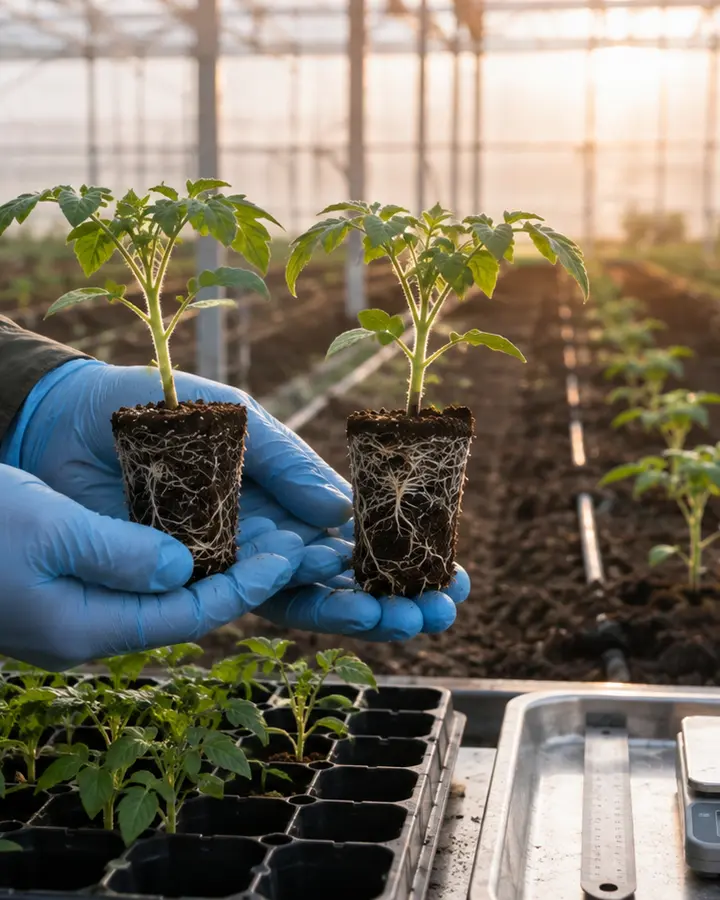
Search results often reduce transplant shock to a single product and a universal dipping rate. Commercial establishment is more complicated. Seedling age, plug volume, hardening, root damage, root-ball moisture, air temperature, radiation, wind and the first irrigation can each change survival and early growth. Unless these factors are balanced, a greener treated row cannot be attributed to the product.
A useful trial asks a narrower question: for one crop, transplant batch, site and application route, does the documented programme shorten the recovery window or improve a predetermined establishment endpoint without creating nutrient imbalance, salt injury or later yield loss? This guide turns that question into a repeatable protocol and deliberately avoids transferring rates from unrelated studies.
KEY TAKEAWAYS
- Treat transplant quality and hardening as baseline variables, not as background detail.
- Do not combine root dip, plug drench and post-transplant fertigation under one treatment name.
- Measure the recovery curve at fixed times; one photograph cannot describe establishment.
- Release only the crop–lot–route combination tested, using the registered label and complete nutrient programme.
1. Define recovery and establishment before the trial
Transplant shock is not one measurable trait. Immediately after planting it may appear as wilting, low leaf-water status or delayed canopy recovery. Over the next days it becomes missing plants, uneven new-leaf appearance or slow root exploration outside the plug. Later it may affect flowering, harvest timing, marketable yield or grade. Choose one primary endpoint and a limited set of supporting measures before the first plant enters the field.
2. Standardize the plants before comparing treatments
University extension guidance treats hardening, root-ball integrity, water status and appropriate transplant age as central to establishment. They must therefore be documented in a product trial. Randomize matched plants across replicated blocks and keep operators, planting depth, hole preparation, irrigation start and observation time consistent.
- Use one cultivar, sowing date, tray size, substrate batch and nursery block.
- Record seedling age, true-leaf stage, height, stem diameter, plug mass and visible root binding.
- Apply the same hardening schedule and quantify root-ball moisture immediately before treatment.
- Reject or stratify damaged, diseased, overgrown and undersized plants before randomization.
3. Keep each application route as a separate treatment
The untreated control must receive the same carrier water and handling. If WSG Root Complete is evaluated, account for every nutrient and co-component it contributes to the complete programme; a response cannot automatically be assigned to the humic fraction alone. Use the registered market label and validate concentration, compatibility and delivery with the actual crop, substrate, water and equipment.
| Route | What must be fixed | Main confounder |
|---|---|---|
| Root dip | Concentration, contact time, solution temperature and carry-over volume | Root damage and unequal uptake |
| Plug drench | Plug moisture, delivered volume, drainage and holding time | Different retained dose per plug |
| Post-transplant fertigation | Timing, irrigation volume, emitter delivery and nutrient background | Water or nutrient effect mistaken for product response |
4. Measure a recovery curve, not a single moment
Preselect plants for destructive sampling and harvest them by a fixed rule; never dig only the best or worst plants. Wash roots consistently, separate roots that grew beyond the original plug when feasible, and document the sampling unit. Photographs are useful when distance, angle, scale and time are standardized, but they remain supporting evidence.
- At planting: plant and plug traits, root-ball moisture, delivered solution and initial stand count.
- First 48 hours: wilting or canopy recovery at the same time of day, plus root-zone moisture and weather.
- Days 7–14: survival, missing plants, new-leaf stage, height or leaf area and plot uniformity.
- A destructive subsample: roots outside the original plug, root and shoot dry mass and root-to-shoot balance.
5. Protect the comparison from operational noise
Use replicated, randomized blocks that follow greenhouse benches, irrigation zones or field gradients. Map every plot. Calibrate transplanting depth and first irrigation, record delays between removal from trays and planting, and log temperature, radiation, humidity and wind during the recovery window. A separate untreated row at the edge is not a valid control for treated rows in the centre.
If the product changes nutrient supply, compare the complete nutrient budget rather than pretending the treatments differ only in humic substances. Check source-water EC and pH, tank compatibility, filtration where relevant and the actual volume delivered. Record any rescue irrigation, shading or replanting by plot; these interventions can erase or create apparent treatment effects.
6. Carry the decision through to harvest
An early root or canopy response matters commercially only if it improves the chosen establishment outcome without a later penalty. Follow plot population, uniformity, flowering or harvest timing, total and marketable yield and crop-specific reject reasons. Report absolute means, variation, sample size and the predeclared analysis; a statistically detectable difference may still be too small or inconsistent to justify an operational change.
Approve only the tested combination of product lot, crop, cultivar, seedling specification, application route, water and site conditions. Keep the protocol, label version, solution record, weather, plot map, raw data and deviations. A second transplant batch or season is valuable where nursery quality or weather varies. A neutral or negative result is a useful release decision; it is stronger than an unsupported promise of shock prevention.
PRACTICAL ANSWERS
Frequently asked questions
Does humic acid eliminate transplant shock?
No universal guarantee is defensible. It can be evaluated as part of a crop-specific establishment programme while hardening, water status, handling and weather remain controlled.
Is a root dip the same as a plug drench?
No. Contact time, exposed root area, retained solution and handling differ. Treat them as separate routes and document each one.
What should be measured first after transplanting?
Confirm plant count, root-ball moisture and delivered water at planting, then score canopy recovery at fixed times during the first 48 hours while recording weather and root-zone moisture.
Can early root growth replace harvest measurements?
No. Root data can explain establishment, but commercial release should also check survival, uniformity, timing, marketable yield and quality where the crop cycle permits.
Can a published application rate be copied?
No. Formulation, crop, plug, water, substrate and regulations differ. Use the applicable registered label and validate the actual product and delivery system locally.
Technical references
- Agriculture: Humic substances, vegetable seedling quality and post-transplant performance
- Horticulturae: Biostimulants for alleviating transplanting shock
- University of Minnesota Extension: Hardening and transplanting vegetable seedlings
- University of Vermont Extension: Growing good vegetable transplants
- University of Georgia Extension: Commercial production of vegetable transplants
This article provides product-selection and operating logic, not a legally binding application rate. Final use follows the registered label, batch documentation, water and soil analysis, and local technical guidance.