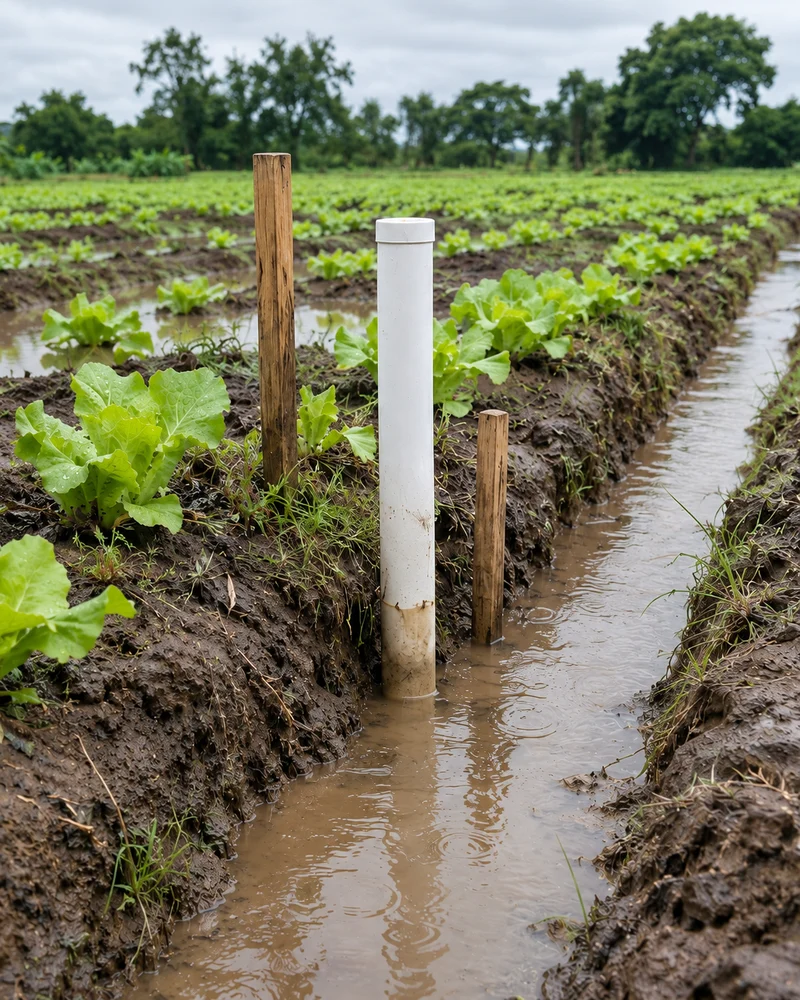
After a wet spell, a greener leaf can be mistaken for proof that an input rescued the crop. But drainage, weather, nutrient management and the original damage all change at the same time. A useful humic-acid assessment must separate those influences before attributing recovery to a product.
This guide proposes a practical assessment for upland field crops and vegetables after excess-water stress. It is not an emergency flood-response plan, a rice-production guide or a promise of recovery. Do not delay drainage or necessary crop-protection decisions to run a product trial.
KEY TAKEAWAYS
- A humic input is not a substitute for restoring drainage and air exchange.
- Compare product and no-product plots with the same drainage, carrier water and recovery care.
- Root survival, renewed growth and marketable harvest matter more than a single colour reading.
1. Record saturation, not just surface puddles
NSW guidance explains that waterlogging can persist below the surface even without visible ponding; oxygen shortage then limits root function. A dry-looking surface is therefore not sufficient evidence that the root zone has recovered.
For the assessment proposed here, map low spots and drainage outlets before choosing plots. Record the crop and growth stage, soil texture, estimated start and end of saturation, rainfall or irrigation, and the depth at which wet conditions remain. Label uncertain timings as estimates. Do not treat a one-day event and repeated saturation as the same exposure.
2. Restore drainage before judging a product
Queensland’s recovery guidance prioritises drainage and gradual nutrient replacement; heavy fertilisation can further damage impaired roots. INRAE’s lettuce guidance also shows that wilt can occur in wet soil through root asphyxia. Wilt alone is not a reason to add more water.
Make the trial conditional on safe access and an agronomist’s decision that a recoverable crop remains. If drainage is still blocked, roots continue deteriorating, or disease or flood contamination is suspected, resolve those questions first. Humic treatment cannot establish disease control or food safety. Keep all necessary corrective care identical between comparison plots.
3. Read the measured endpoint, not a rescue promise
Pitann and colleagues’ 2024 maize experiment found a zinc-status response under waterlogging without consistent growth rescue. A 2026 snake-cucumber seedling experiment reported physiological and biomass improvements in pots. These are different endpoints, crops and formulations, not interchangeable field guarantees.
Our interpretation is to treat such findings as reasons to test a specific product, not reasons to bypass drainage. A wheat recovery experiment also found persistent root-system effects after drainage. Therefore, build a recovery period into the assessment instead of stopping measurements when surface water disappears.
4. Compare like-for-like recovery
The following is a proposed decision protocol, not a published MetraHum efficacy result. Within each reasonably uniform damage zone, allocate replicated plots randomly to the recovery programme alone or the same programme plus the candidate product. Match variety, stage, drainage timing, irrigation, nutrient inputs and carrier-water volume. Record any unavoidable differences.
A nearby well-drained area can provide a reference for normal growth, but it is not a valid substitute for the affected no-product control. Never compare a treated high spot with an untreated hollow and call the difference a product effect. In commercial crops, do not withhold necessary drainage to create a stressed control.
5. Follow roots through recovery and harvest
Choose observation dates before seeing the results. For example, baseline and days 3, 7 and 14 after drainage can organise a short pilot; these are proposed recording intervals, not universal recovery deadlines. Use the same observation method and time of day. Reserve separate plants for destructive root sampling so that sampling itself does not change the harvest comparison.
| Record | Keep comparable | Decision value |
|---|---|---|
| Root condition | Same depth, number of plants and scoring rule | Distinguishes continuing damage from new root growth |
| Survival and new leaves | Fixed marked plants; count losses as well as survivors | Shows recovery trajectory rather than one photograph |
| Leaf colour or SPAD | Same leaf position and instrument procedure | Supporting observation, not a yield or oxygen measurement |
| Marketable harvest | Same area, maturity rule and grading standard | Tests whether early differences survive to an economic outcome |
6. Qualify the exact product and decide
MetraHum’s relevant route is Root/Stress Liquid, a combined humate, seaweed and amino-acid formulation for root and selected stress programmes. It is a candidate for evaluation, not a demonstrated waterlogging rescue treatment. A response to this blend cannot be attributed to humic acid alone. Confirm the current local label, lot documentation, permitted route and crop safety; do not transfer a research dose to this formulation.
Before starting, write the minimum improvement that would justify cost and the conditions that would invalidate comparison. Report plot-level differences, variation and losses, not only the best plants. Continue cautiously only if safety is acceptable and the recovery or harvest advantage is repeatable. Hold the decision if drainage or nutrition differed. Reject the proposed use if injury increases or the required benefit is absent; do not hide a neutral result.
PRACTICAL ANSWERS
Frequently asked questions
Can humic acid replace drainage?
No. This guide treats drainage as a prerequisite and evaluates the product only as an additional input under comparable recovery conditions. It assigns no oxygen-supply or drainage capacity to a humic formulation.
Does a greener leaf prove that roots recovered?
Not by itself. In this protocol, colour is a supporting observation. Examine roots consistently, count plant losses and track new growth and harvest against the affected no-product control.
What dose should be used after waterlogging?
There is no universal dose in this guide. Use only an eligible crop and route under the current local label and professional advice, followed by a small safety trial. A published experimental concentration is not a MetraHum recommendation.
Technical references
- NSW Government — Managing waterlogging in crops
- Queensland Government — Crop recovery after flooding
- INRAE — Root asphyxia in lettuce
- Pitann et al. (2024) — Foliar humic acid and water-stressed maize
- Frontiers in Plant Science (2026) — Humic substances and waterlogged snake cucumber
- New Phytologist (2001) — Persistent effects of short-term waterlogging in wheat
This article provides product-selection and operating logic, not a legally binding application rate. Final use follows the registered label, batch documentation, water and soil analysis, and local technical guidance.