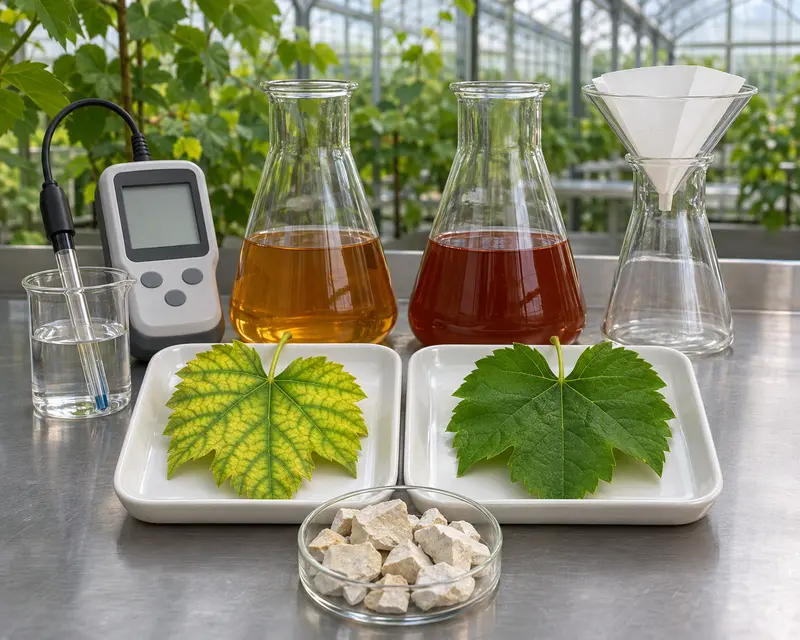
“Chelated” and “complexed” are not automatic synonyms. A chelating agent binds a metal through several donor sites in a defined molecular arrangement; a complexing agent can associate with the metal through a different structure. Humic substances contain diverse functional groups and can bind iron, but that chemistry does not justify relabelling every humic–iron product as a synthetic chelate. The permitted terminology and declaration depend on the destination market, the named agent and the analytical evidence.
A defensible WSG-Fe programme starts after iron limitation has been diagnosed. It then follows an evidence chain from label and certificate of analysis to pH stability, real-water behaviour, crop safety and a controlled response comparison. The purpose is not to declare one iron form universally superior. It is to decide whether the exact product, lot, route and crop programme are supported for the local use case.
KEY TAKEAWAYS
- Use “chelated” or “complexed” only when the market label, named agent and analytical method support that term.
- Total iron alone does not establish the water-soluble, chelated or complexed fraction.
- Release the exact lot only when declaration, stability, real-water behaviour, crop safety and response evidence agree.
1. Classify the product term from the market label
Start with the legally applicable label, not a sales adjective. Record the declared iron forms, total and water-soluble iron, any chelated or complexed amount, the name of each chelating or complexing agent, and any stated pH-stability range. In the EU framework, chelating and complexing agents have distinct definitions and the label distinguishes chelated from complexed micronutrients. Other markets may use different categories, thresholds or accepted methods, so the destination rule must be checked rather than copied.
| Label question | Evidence to retain | Decision use |
|---|---|---|
| What iron fraction is guaranteed? | Total, water-soluble, chelated and/or complexed Fe with units and reporting basis | Prevents a total-Fe result from standing in for the active declared fraction |
| Which agent is named? | Chemical name or accepted abbreviation and market status | Separates a supported product term from an undefined claim |
| Where is stability claimed? | pH range, solution, duration, temperature and test method | Defines what can be challenged in real water |
2. Verify iron fractions and method scope
A certificate that reports only total iron cannot prove how much iron is water-soluble, chelated or complexed. Request the declared fractions on the same reporting basis and with methods suitable for the actual matrix. A general method for complexed micronutrients may quantify the complexed fraction without identifying the individual complexing agent; identity and quantity claims may therefore require additional method-specific evidence.
Check sample identity, lot number, sampling plan, laboratory competence, extraction procedure, instrument, limit of quantification and uncertainty. Keep the original units and dry/as-received basis before any conversion. If the label term, agent identity and analytical fraction do not align, place the lot on hold; do not repair the discrepancy with a marketing description.
3. Challenge pH stability in the real water and route
A pH range is meaningful only with its test solution, concentration, duration, temperature and acceptance rule. It is not a universal promise for every bicarbonate, calcium, phosphate or stock-tank condition. Reproduce the intended dilution with the actual source water. Record initial and final pH and electrical conductivity, clarity, colour change, sediment, filterable residue and redispersibility at predetermined times. Include a water blank and the intended standard reference when permitted.
Physical clarity is a screen, not proof that iron remains in the declared chemical fraction. When the claim requires it, analyse the retained solution after the stability challenge using the applicable method. Do not infer chelation from dark colour, absence of visible sediment or a single pH measurement.
4. Separate iron diagnosis from product choice
Interveinal chlorosis is not a product-selection result by itself. Confirm crop and leaf age, symptom pattern, root-zone pH and bicarbonate pressure, irrigation history, root condition and the locally appropriate tissue or soil interpretation. Rule out look-alike causes such as manganese imbalance, root damage, waterlogging or cold roots. Only after the diagnosis should the programme compare an iron source and route.
Route changes the question. A foliar strip mainly tests leaf safety and short-term greening at the treated surface; it does not establish root-zone persistence. A fertigated programme must pass dissolution, source-water and emitter-risk checks. A soil-applied programme must account for placement, pH, carbonate, wetting pattern and root access. Use only routes and rates permitted by the current local label.
5. Run a controlled crop comparison
Randomize independent blocks across the diagnosed area. At minimum include an untreated control and the exact WSG-Fe lot; add a locally accepted iron reference where the label and trial purpose allow. Keep irrigation, base nutrition, crop load, rootstock, pruning, substrate or soil zone and sampling dates equal. If programmes cannot legally or practically be compared at equal elemental iron, record the actual iron contribution and compare complete programmes rather than pretending they are dose-equivalent.
Predefine one primary endpoint: standardized chlorosis score, calibrated chlorophyll index, marketable yield or another locally defensible measure. Support it with leaf photographs under fixed light, crop-safety scoring, tissue analysis at the correct leaf position and a persistence measurement. Analyse plot-level values, not individual leaves as independent replicates. A darker leaf without safety, persistence or crop value is not enough for product release.
6. Release, hold or reject the product lot
| Decision | Minimum evidence | Typical trigger |
|---|---|---|
| Release | Label term, agent, declared fractions and lot CoA align; real-water stability and crop safety pass; response meets the predeclared rule | Coherent evidence for the exact lot and route |
| Hold | Identity or method is incomplete, stability result is borderline, or trial data are underpowered | Resolvable evidence gap |
| Reject or redesign | Unsupported product term, off-spec declared fraction, persistent precipitate/filter risk, crop injury or no repeatable response | Evidence contradicts the claim or programme |
PRACTICAL ANSWERS
Frequently asked questions
Is humic-complexed iron the same as chelated iron?
Not automatically. The terms describe different coordination and regulatory categories in some markets. Use the term supported by the named agent, applicable label and validated analytical method.
Does a wide pH-stability range guarantee correction of iron chlorosis?
No. It describes performance under specified test conditions. Diagnosis, water chemistry, placement, crop physiology, safety and persistence still determine the field result.
Is total iron on a CoA enough to qualify the product?
No. Qualification needs the fractions actually declared on the label, a method appropriate to the matrix and evidence that identity, stability and crop use align.
Can humic-complexed iron universally replace EDDHA or another chelate?
No universal substitution is defensible. Chemistry, legal label, pH, carbonate pressure, route, crop and application pattern differ. Compare permitted programmes under the actual use conditions.
Technical references
- Regulation (EU) 2019/1009 — chelating and complexing agents and micronutrient labelling
- European Commission — harmonised standards for fertilising products
- DIN EN 15962 — determination of complexed micronutrient content and fraction
- Humic substances in plant iron nutrition — peer-reviewed review
- Iron-humate accumulation on roots under calcareous conditions — peer-reviewed study
- University of Florida IFAS — chelated fertilisers and soil pH
This article provides product-selection and operating logic, not a legally binding application rate. Final use follows the registered label, batch documentation, water and soil analysis, and local technical guidance.