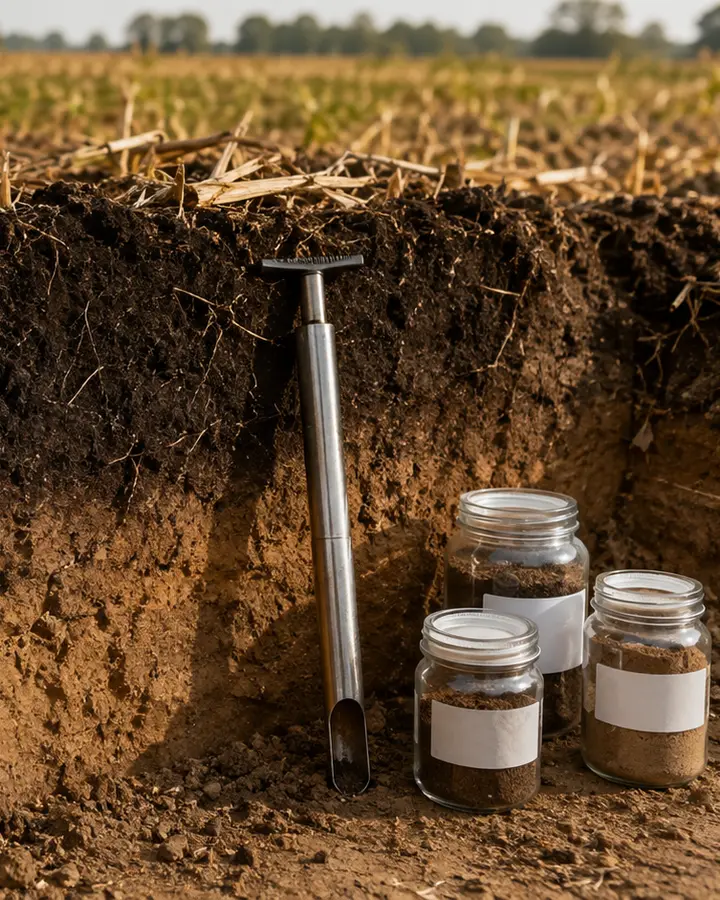
Humic acid, humus, soil organic matter and soil organic carbon are often used as though they were four labels for one number. They are not. Soil organic matter is a broad pool of plant-, animal- and microbe-derived materials at different stages of transformation. Soil organic carbon is the carbon contained in that pool. Humic acid is an operationally separated fraction—or, in commerce, a declared component of a humic product.
This distinction matters commercially and agronomically. Applying a carbon-containing product is an input event; demonstrating a change in soil organic matter is a monitored field outcome. The second requires a defined baseline, consistent sampling, a stated laboratory method and enough time to separate real change from spatial and seasonal variability.
KEY TAKEAWAYS
- Humic acid is related to soil organic matter, but the terms are not analytically interchangeable.
- SOC, SOM and extractable humic fractions answer different questions and must be reported with their methods and basis.
- Product application does not by itself prove a measurable increase in field soil organic matter.
- Repeat monitoring is credible only when depth, location logic, timing, preparation and laboratory method remain comparable.
1. Four related terms, four different meanings
Soil organic matter includes recognizable residues, microbial biomass and transformation products associated with minerals. Humus is used inconsistently: some sources use it for the more transformed part, others as a loose synonym for soil organic matter. For specifications and reports, the measured analyte is safer than the word humus.
Humic acid and fulvic acid are conventionally defined by extraction and pH-dependent separation. That makes them useful operational fractions, not a complete inventory of everything organic in intact soil. Modern soil science also describes soil organic matter as a continuum whose persistence depends strongly on microbial processing, mineral association, aggregation and environmental conditions.
| Term | What it describes | Do not assume |
|---|---|---|
| Soil organic matter (SOM) | Broad organic pool in soil | That it equals humic acid |
| Soil organic carbon (SOC) | Carbon within the organic pool | A universal SOM conversion factor |
| Humic acid | An operationally separated fraction | A complete measure of soil organic matter |
| Humic product | A formulated agricultural input | A guaranteed field SOC increase |
2. What a soil report actually measures
A laboratory may report organic carbon by dry combustion, organic matter by loss on ignition, or an estimate converted from carbon. These results are not automatically identical. Carbonates matter in calcareous soils because total carbon includes inorganic as well as organic carbon unless the method separates or corrects for it. Loss on ignition can also respond to mineral water loss, so method, temperature programme and soil type belong with the result.
A product CoA and a soil report also answer different questions. The CoA qualifies the delivered material—its declared humic fraction, moisture, ash or solubility under a stated method. The soil report characterizes the sampled field volume. A high humic value on the product CoA cannot be copied into the soil’s SOM line, and a field SOM result cannot verify the product’s declared humic content.
3. Why an applied input is not yet a soil outcome
The carbon entering a field can be transformed, respired, dissolved, transported, incorporated into biomass or associated with mineral surfaces. The measured result depends on input quantity and composition, existing soil carbon, texture and mineralogy, moisture and temperature, tillage, residue return, erosion and sampling design. For that reason, a humic application may belong in a soil-management programme without being presented as a one-step replacement for crop residues, organic amendments, living roots or erosion control.
The responsible claim is therefore specific: state what was applied, why that product form fits the operation, and what will be measured. If the objective is soil organic matter, define the indicator and monitoring horizon. If the objective is operational—such as distributing a natural granule through dry equipment or dosing a soluble concentrate through irrigation—verify that route separately.
4. Build a repeatable baseline before judging change
Divide the field into management zones that are internally comparable; do not merge visibly different soil, slope, irrigation or management histories into one number. Take multiple cores per zone and combine them according to the agreed laboratory protocol. Avoid atypical points such as headlands, manure piles, wheel tracks or localized spills unless they are the explicit target.
Repeat at the same depth, comparable season and soil condition, preferably with the same accredited laboratory and method. Concentration alone can be misleading when bulk density changes; carbon-stock monitoring therefore uses sampled depth and bulk density to express mass per area. Preserve coordinates, field map, sampling notes and raw reports so the next result is truly comparable.
- Fix the management zone and sampling pattern.
- Record depth, date, crop stage and recent inputs.
- Use the same analyte, method and reporting basis.
- For stock claims, include bulk density and area.
5. Place humic products inside the wider soil programme
Product form should follow the delivery route and the documented objective. SOIL-G is the natural granular route for mechanical distribution and soil incorporation. WSG Core and K18 support soluble dosing routes where dissolution, water quality, filtration and compatibility are controlled. BLACK-S follows a liquid or suspension route whose homogeneity and equipment fit must be verified. These choices describe handling and formulation; none changes the definition of the field’s SOM test.
A complete programme may also manage residue return, cover or living roots, disturbance, erosion, organic amendments and nutrient balance according to local conditions. Do not select a universal humic dose from a blog article. Start with soil analysis, registered label, product specification, local agronomic guidance and a small documented validation area when conditions or equipment are uncertain.
6. A defensible decision and monitoring record
Keep two linked records. The input record contains product identity, lot, CoA, declared method and basis, application route, date and field area. The soil record contains zone map, coordinates, depth, composite-sample design, laboratory method, SOC or SOM result and, where relevant, bulk density. Linking the records supports learning without pretending that the two measurements are the same.
At review, ask three separate questions: Did the correct product reach the intended area through the planned route? Did the wider management programme operate as documented? Does the repeated soil measurement exceed expected analytical and spatial variability? Only then should a field trend be described, and the wording should match the strength and duration of the evidence.
PRACTICAL ANSWERS
Frequently asked questions
Is humic acid the same as soil organic matter?
No. Humic acid is an operationally defined fraction or a component declared in a humic product. Soil organic matter is a much broader pool that includes residues, microbial material and transformation products associated with the soil matrix.
Does applying humic acid automatically increase the soil-test SOM percentage?
No automatic conclusion is valid. A field result depends on product amount and composition, background soil, management, climate, sampling design and analytical variability. Demonstrate change through a consistent baseline and repeat monitoring rather than through the application record alone.
Is soil organic carbon the same number as soil organic matter?
No. SOC measures carbon in the organic pool; SOM is a broader mass estimate. Laboratories may convert SOC to SOM with a factor, but the factor is not universal across all soils and methods. Compare results only when the analyte and calculation are stated.
How should a field be monitored after a humic-product application?
Preserve a pre-application baseline, management-zone map, coordinates, depth, sampling pattern and laboratory method. Repeat under comparable conditions and keep the input lot and application record separate but linked. For carbon-stock claims, include bulk density and sampled depth.
Technical references
- USDA NRCS — Soil Organic Carbon: terms and measurement context
- FAO Global Soil Partnership — What is soil organic carbon?
- FAO GLOSOLAN — Standard operating procedure for soil organic matter by loss on ignition
- International Humic Substances Society — What are humic substances?
- Lehmann & Kleber — The contentious nature of soil organic matter, Nature
- USDA NRCS — Soil Organic Carbon Stock Monitoring (CEMA 221)
This article provides product-selection and operating logic, not a legally binding application rate. Final use follows the registered label, batch documentation, water and soil analysis, and local technical guidance.