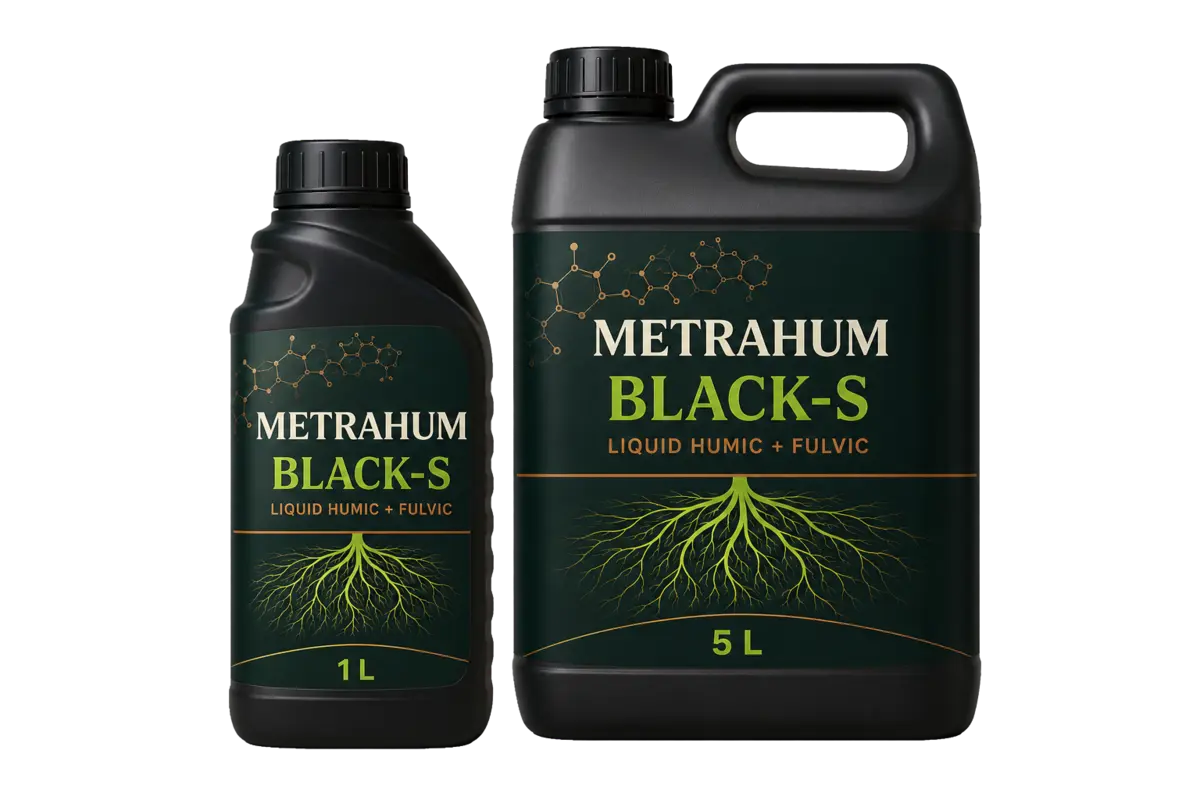
“Liquid humic acid” is a market label, not a complete physical description. It may refer to an alkaline liquid containing dissolved potassium humate, or to a liquid in which fine natural-leonardite particles remain dispersed. Both can be dark, pumpable and humic-material based, yet their behaviour in storage, dilution, filtration and irrigation equipment is fundamentally different.
The correct selection therefore starts with product identity: what was extracted, what remains as a solid phase, how particle size was measured, whether sediment can be redispersed and how the complete product behaves in the buyer’s actual water and hardware. Colour, pH or one D₉₀ value cannot answer all of those questions.
KEY TAKEAWAYS
- A solution and a suspension are different physical systems even when they have the same colour and both contain humic material.
- D₉₀ describes a particle-size distribution under a stated method; it does not prove dissolution, define the largest particle or guarantee emitter passage.
- Suspension quality must include sedimentation, hard-cake risk and redispersibility—not only the initial particle-size result.
- Validate the complete diluted product in the actual water, pump, agitation, filter and emitter system before operational use.
1. Name the physical system before comparing labels
IUPAC defines a suspension as a liquid in which solid particles are dispersed. That solid phase can sediment and form a concentrated layer while remaining in contact with the liquid phase. A dissolved potassium-humate liquid is instead prepared by alkaline extraction or neutralisation so that the intended humate fraction is carried in the liquid phase under the stated conditions.
Neither architecture is universally superior. The decision depends on whether the program requires a clear dissolved concentrate or the native mineral-humic matrix in a pumpable particulate form—and whether the application system can manage that form. Ask the supplier to state extraction route, solid phase, intended delivery route and whether “soluble,” “dispersible” or “suspendable” is the technically correct term.
2. Read D₉₀ as a distribution value—not a solubility claim
In a volume-based particle-size distribution, D₉₀ is the diameter below which 90% of the measured particle volume is reported. It is not necessarily the largest particle: an oversize tail can remain above it. State D₁₀, D₅₀ and D₉₀ together and add an oversize control relevant to the process risk.
ISO 13320:2020 covers laser-diffraction measurement for two-phase systems including suspensions. The result depends on sampling, dispersion state, optical model, refractive-index inputs and instrument settings; non-spherical particles are represented through an equivalent-sphere model. A supplier value and an incoming-lot value are comparable only when the method and preparation are aligned.
3. Build the specification around the physical architecture
Use a documented method for every value. Viscosity, for example, is incomplete without temperature, instrument geometry and shear condition. Particle size is incomplete without dispersion preparation. Sedimentation is incomplete without container geometry, storage time and temperature. Universal acceptance limits should not be copied from another formulation; set them after process and shelf-life validation.
| Control | For a solution | For a suspension |
|---|---|---|
| Identity | Extraction chemistry, humate fraction and counter-ion | Source, micronisation route, solid phase and dispersing system |
| Composition basis | Humic fractions by stated method, dry matter, density, K or K₂O and pH | The same, plus mineral solids and mass balance of the dispersed phase |
| Physical behaviour | Clarity or defined insoluble residue under stated conditions | D₁₀/D₅₀/D₉₀, oversize, viscosity, sedimentation and redispersibility |
| Delivery risk | Precipitation after dilution or incompatible tank partners | Settling, agglomeration, hard cake, filter loading and emitter passage |
| Operating requirement | Defined dilution order and compatibility check | Defined agitation/recirculation, dilution, filtration and cleaning procedure |
4. Test sedimentation and redispersibility as separate properties
Some settling can occur in a physically stable, usable suspension. The operational question is whether the settled phase forms a loose sediment that returns to a representative dispersion under the stated mixing procedure, or a compact hard cake that does not. Record sediment height or volume, supernatant condition, time to redisperse, mixing energy, residual lumps and concentration uniformity after redispersion.
Accelerated heat, cold or centrifuge tests can compare formulations, but they do not automatically predict real shelf life. Correlate accelerated results with retained samples stored in the commercial pack under defined conditions. Recheck after transport simulation because vibration and temperature cycles can alter sediment structure.
5. Validate filtration with the complete delivery system
FAO’s pressurised-irrigation handbook treats filtration, water quality, drip equipment and maintenance as connected design questions. A particle-size value alone cannot define compatibility. Particles can agglomerate after dilution, interact with salts or organic matter in the water, load the filter progressively, or settle in low-velocity zones.
Run a circulating pilot with the actual dilution water, intended concentration, mixing tank, pump, pipe residence time, filter type and opening, and the exact emitter or nozzle model. Record pressure differential, flow change, filter residue, settling and cleaning recovery over a defined duration. A jar test remains useful for rapid incompatibility screening, but it does not reproduce pump shear, recirculation, filter loading or emitter geometry.
6. BLACK-S and K18 represent different liquid routes
Within the MetraHum architecture, BLACK-S is positioned as a non-alkaline-extracted, ultramicronised natural-leonardite suspension for soil and root-zone systems that can maintain agitation and suitable filtration. K18 is positioned as an alkaline liquid potassium-humate concentrate for repeatable liquid dosing. They are not interchangeable descriptions of the same product.
Use BLACK-S only as a suspension: maintain the solid phase during storage preparation and dosing, and validate filters and emitters. Evaluate K18 as a dissolved alkaline concentrate: verify analysis method and basis, dilution behaviour and tank compatibility. For both routes, final composition, application, dose and compatibility must follow the registered label, current batch documentation, water and soil analysis and local technical guidance.
7. Release each batch against documents and process checks
- Confirm product identity, lot code, pack seal and transport condition.
- Reconcile the lot-specific CoA with the signed specification, current TDS, SDS and registered label.
- Homogenise or sample the container by a defined plan before testing a suspension.
- Check risk-critical physical attributes and compare them with the qualified reference lot.
- Retain a sealed sample and record the release decision, method, operator and date.
PRACTICAL ANSWERS
Frequently asked questions
Is every liquid humic-acid product a true solution?
No. Some products carry dissolved humate fractions; others are suspensions of fine natural-leonardite particles. Ask for the extraction route, solid phase, particle-size data, insoluble-residue method and preparation instructions.
Does D₉₀ below 5 µm mean the product is water soluble?
No. It describes the measured particle-size distribution of a dispersed solid under the stated method. It does not demonstrate molecular dissolution and does not exclude an oversize tail above D₉₀.
Is sedimentation always a product failure?
Not necessarily in a suspension. The acceptance question is whether settling remains within the validated limit and whether the sediment redisperses completely under the documented procedure without hard cake or persistent lumps.
Can a jar test prove emitter compatibility?
No. It can reveal rapid precipitation, flocculation or separation, but it does not reproduce pump shear, residence time, recirculation, progressive filter loading or emitter geometry. Use a circulating pilot with the actual system.
How should BLACK-S and K18 be selected?
Choose by objective and hardware, not colour. BLACK-S is the suspension route for delivering a micronised native matrix where agitation and filtration are available; K18 is the dissolved alkaline potassium-humate route for liquid dosing. Confirm the final choice against the registered label, batch documents, water and soil analysis and local technical guidance.
Technical references
- IUPAC Gold Book — Suspension of solid charged particles
- ISO 13320:2020 — Particle size analysis by laser diffraction
- FAO — Technical Handbook on Pressurized Irrigation Techniques
- ISO 19822:2018 — Determination of humic and hydrophobic fulvic acids
- European Union — Regulation (EU) 2019/1009 on fertilising products
This article provides product-selection and operating logic, not a legally binding application rate. Final use follows the registered label, batch documentation, water and soil analysis, and local technical guidance.