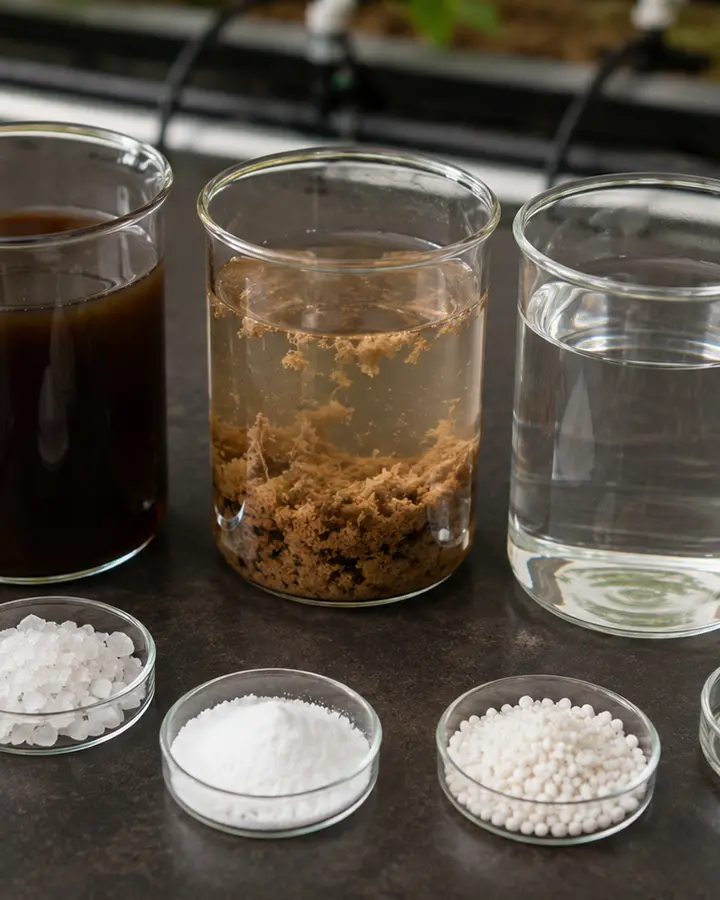
“Compatible with most fertilizers” is not a permanent property of potassium humate. Compatibility belongs to one complete mixture: the exact humic product and lot, partner formulation, irrigation water, concentration, temperature, order of addition, agitation, contact time and application equipment. Change one of these variables and a previously clear mixture may form haze, flocs, gel or sediment.
Current sector pages commonly advise a pre-mix test, yet a useful test must reproduce the intended water and concentration. It is a risk screen, not a guarantee: a visually stable jar does not prove chemical efficacy, crop safety, label permission or emitter performance at field scale. Final use must follow every registered label, batch document, water analysis and qualified local guidance.
KEY TAKEAWAYS
- There is no universal potassium-humate compatibility chart; product form, water chemistry and concentration control the outcome.
- Strong acidification can reduce humic-acid solubility, while calcium and magnesium can promote aggregation under some conditions.
- Run the jar test with the actual source water, proportional rates, intended order of addition and realistic hold time.
- A physical pass does not authorize a tank mix; labels, batch documents, safety data and local technical guidance remain decisive.
1. Separate physical, chemical and application compatibility
Physical incompatibility is visible as haze, flocculation, curdling, gel, persistent foam, layer separation or sediment. Chemical incompatibility may remain invisible while pH changes, active ingredients degrade or nutrients form less available compounds. Application incompatibility occurs when a mixture that looks acceptable still exceeds the filter, nozzle, emitter, pump or storage tolerance. A jar test mainly addresses the first category and only part of the third.
| Compatibility layer | Evidence | Decision |
|---|---|---|
| Physical | No unacceptable floc, gel, separation, sediment or filter residue during the intended hold time | Proceed only to further checks |
| Chemical | Label-supported combination and verified pH, stability and nutrient or active integrity | Use qualified formulation or agronomic review |
| Application | Pilot passes the real filter, pump, emitter or nozzle without unstable hold behaviour | Release only for the validated system |
2. Why pH, calcium and ionic strength change humate behaviour
Potassium humate is commonly supplied as an alkaline, soluble humate salt. Strong acidification can protonate humic groups and reduce the solubility of the humic-acid fraction. Divalent ions such as calcium and magnesium can bind to charged humic groups and, depending on product, pH, concentration and ionic strength, promote larger aggregates. Research on Leonardite humic acid confirms that calcium-driven aggregation is condition-dependent rather than a universal yes-or-no reaction.
Separate this humate behaviour from ordinary fertilizer precipitation. Calcium can also form sparingly soluble compounds with phosphate or sulfate, especially in hard, alkaline water. A failed mixed tank may therefore contain humic aggregates, calcium phosphate, calcium sulfate or several solids at once; appearance alone does not identify the chemistry.
3. Treat irrigation water as a formulation ingredient
Use a current analysis of the exact water source. At minimum, review pH, electrical conductivity, alkalinity or bicarbonate, calcium, magnesium, sulfate, iron and temperature. Utah State University notes that high bicarbonate and high dissolved calcium or magnesium increase precipitation risk, with phosphate sources particularly sensitive in water around pH 7.5 or higher. That observation is a screening signal, not a universal threshold for humates.
Do not perform the jar test with distilled water if the field system uses a well, reservoir or recycled drainage water. Seasonal water changes, blending of wells and acid treatment can invalidate an older result. Repeat the test after a source, formulation, lot, concentration or operating condition changes.
4. Screen the highest-risk mixing partners first
| Partner or condition | Potential mechanism | Responsible control |
|---|---|---|
| Strong acids or acidified stock | Rapid pH fall can reduce humic-acid solubility; concentrated contact can create local precipitation | Never improvise concentrate-to-concentrate mixing; follow labels, SDS and a validated dilution sequence |
| Calcium or magnesium sources | Divalent-ion binding and aggregation; additional precipitation with phosphate or sulfate | Test the complete mixture in actual water; separate stock tanks or injection windows when validation fails |
| Phosphate or sulfate fertilizers | Calcium phosphate or calcium sulfate may precipitate in hard water, independently of the humate | Use water analysis and source-specific fertigation guidance; spatially or temporally separate when required |
| Micronutrients, pesticides and biologicals | Formulation-specific pH, salts, solvents, surfactants or living-organism sensitivity | No family-wide assumption: all labels must permit the mix and a product-specific test is required |
5. Run a documented jar test that represents the field mixture
- Confirm every registered label and safety data sheet permits the intended use and mixing route before opening products.
- Collect the actual source water at its operating temperature; record pH, EC, hardness-related ions and sample time.
- Scale every component proportionally to the intended tank concentration; do not test arbitrary spoonfuls or concentrated products neat.
- Reproduce the intended dilution, order of addition and agitation. Prepare soluble dry humate separately when its label requires pre-dissolution.
- Observe immediately, after the operating mixing interval and through the maximum intended tank hold time; compare with single-product controls.
- Record temperature change, gas, odour, persistent foam, haze, flocs, gel, separation, sediment, redispersibility, pH and filter residue.
- Stop and obtain qualified guidance if the mix heats, releases gas, gels, forms persistent solids or behaves differently from its controls.
6. Turn observations into a release decision
| Observation | Interpretation | Next action |
|---|---|---|
| Stable appearance and acceptable filter result | Physical screen passed only for this recipe and water | Review labels and chemistry, then run a controlled equipment pilot |
| Reversible settling in a labelled suspension | May be normal for that product, but still challenges tank and filter management | Use the product-specific redispersion and equipment validation protocol |
| Persistent haze, flocs, gel or sediment | Physical incompatibility or precipitation is likely | Do not inject; separate products or seek a validated reformulation |
| Heat, gas or unexpected reaction | Potential safety hazard | Stop handling, isolate safely and follow SDS and emergency guidance |
7. Match the test to the MetraHum product route
WSG Core is a soluble microgranule route: verify complete pre-dissolution, then test the diluted solution with the partner product and actual water. K18 is a pumpable alkaline liquid route: use lot-specific density, pH and concentration when scaling the jar. BLACK-S is a suspension route: follow its documented mixing and redispersion conditions and distinguish expected reversible settling from new flocculation. WSP B2B is an industrial powder route: formulation customers need bench and pilot work in the complete final formulation, not a raw-material jar alone.
No page can prescribe a universal combination or dose. Use the current registered label and batch documentation for each product, the current water and soil analysis, and local technical guidance. When products cannot share a stock tank, separate tanks, dilution stages or injection windows may be evaluated by the system designer; the decision must be validated in the actual installation.
PRACTICAL ANSWERS
Frequently asked questions
Can potassium humate be mixed with calcium nitrate?
No universal yes is responsible. Calcium can promote humic aggregation, while water chemistry and other tank partners can create additional precipitates. Follow both labels and SDS, test the exact products and water, and separate stock tanks or injection windows if the validated mixture fails.
Can an acid be added to potassium humate?
Strong local acidification can reduce humic-acid solubility and may create precipitate. Never mix concentrated acid and concentrated humate by improvisation. Use only a label- and SDS-supported, professionally validated dilution and addition sequence.
How long should a potassium-humate jar test be observed?
Check immediately, after the intended mixing interval and through the maximum planned tank hold time. There is no single universal duration: use the product labels, the actual operation and any qualified protocol, and document every observation time.
Does a clear jar prove the tank mix is safe?
No. It only indicates that obvious physical incompatibility was not observed under those small-scale conditions. Chemical degradation, crop effects, label restrictions and full-scale filter or emitter performance require separate review and validation.
Should incompatible products be added in a different order?
Order and dilution can prevent local over-concentration, but they do not repair a fundamentally incompatible chemistry. Do not search for an improvised order after a failed test; separate the products or obtain a professionally validated formulation and procedure.
Technical references
- Utah State University Extension — Fertigation Facts
- Utah State University Extension — Chemigation Guide
- University of California ANR — Prevention and Mitigation of Precipitation
- University of Florida IFAS — Five Rs of Nutrient Stewardship for Fertigation
- ACS Omega — Strength of Humic Acid Aggregates: Divalent Cations and pH
This article provides product-selection and operating logic, not a legally binding application rate. Final use follows the registered label, batch documentation, water and soil analysis, and local technical guidance.