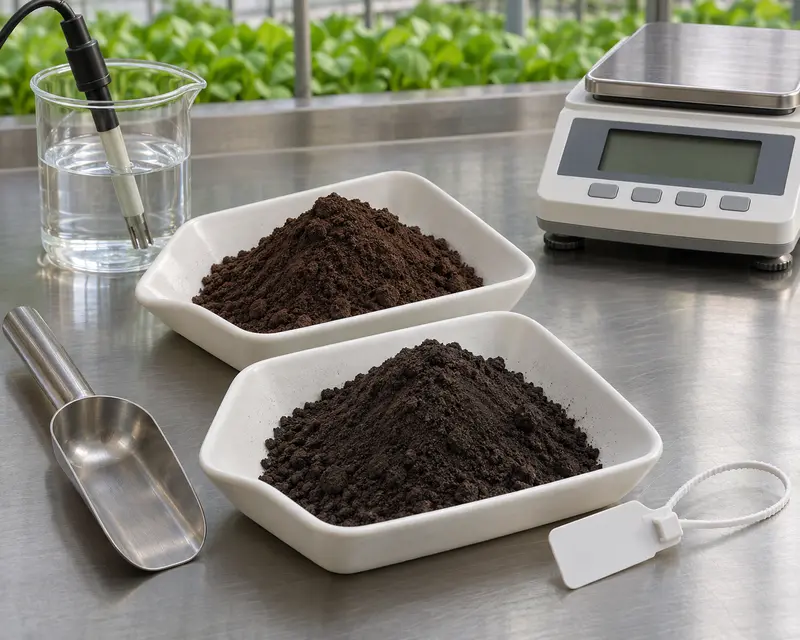
Potassium humate and sodium humate are salts of humic substances, but the cation is not a decorative word. Potassium and sodium enter different nutrient and soil-physical balances. The product name alone still does not reveal how much of either ion is present, whether the result is reported as element or oxide, or how much will reach one tank or hectare.
A defensible purchase therefore starts with the legally applicable label and the certificate for the exact lot. It then converts the declared analysis into delivered sodium and potassium, places that increment beside irrigation-water EC and SAR and relevant soil indicators, and finishes with a dissolution, compatibility and small-area safety check. This workflow does not declare one salt universally superior and does not transfer a literature rate.
KEY TAKEAWAYS
- Qualify the exact lot, not the words “potassium” or “sodium” on their own.
- Normalize element/oxide and dry/wet bases before comparing analyses.
- Calculate delivered Na and K, then interpret sodium beside water EC–SAR and soil context.
- Release only the exact product, lot, route and programme supported by coherent evidence.
1. Classify the salt form and reporting basis
Begin with the destination-market label. Record the named salt form, humic and fulvic fractions, moisture or dry matter, water-soluble potassium, sodium, pH, conductivity and water-insoluble matter where declared. A potassium-humate name does not prove zero sodium; a sodium-humate name does not describe every accompanying nutrient or soluble salt.
Do not compare numbers until the basis is aligned. Potassium may be reported as K or K2O; sodium as Na or Na2O; humic concentration on an as-received, dry-matter or dry-ash-free basis. The certificate must state the method, unit and basis. If moisture is needed for conversion but absent, the comparison is incomplete rather than approximately correct.
| Certificate field | What to verify | Why it changes the decision |
|---|---|---|
| Salt identity | Named potassium, sodium, mixed or other alkali form and permitted market term | Prevents a product name from replacing chemical identity |
| Na and K/K2O | Exact-lot result, method, unit, detection limit and element/oxide basis | Enables a defensible ion-load calculation |
| Moisture and insolubles | As-received versus dry basis and method at a stated temperature | Controls concentration comparison and system suitability |
| pH and conductivity | Sample concentration, water, temperature and method | Makes unlike laboratory values comparable |
2. Verify the exact lot rather than a generic grade
Link the purchase order, sealed sample, label, certificate and laboratory submission with one lot code. A supplier’s typical data sheet can define questions, but it cannot release a shipment. Use a competent independent laboratory when identity or the sodium decision is commercially material, and retain the sampling plan and chain of custody.
Interpret disagreement explicitly. A mixed alkali result, an unexpected sodium concentration, a different dry-basis conversion or an insoluble fraction outside the agreed specification is not repaired by averaging documents. Put the lot on hold, resolve method and sampling uncertainty, and resample only under a written rule.
3. Calculate the exact sodium and potassium load
For a solid product, delivered ion mass equals product mass multiplied by the verified mass fraction of that ion. For a liquid, first convert volume to mass with the verified density at a stated temperature. Keep K, K2O, Na and Na2O separate until a documented conversion is applied. The calculation must use the proposed local programme, not a rate copied from a paper.
Report the result per batch, hectare and season where relevant, and add every other sodium and potassium source: irrigation water, basal and fertigated fertilisers, conditioners and process water. The humate increment may be small or material; only the completed balance can show which. Do not credit potassium as plant-available fertiliser unless the applicable declaration and nutrient plan permit that credit.
| Calculation step | Required input | Control |
|---|---|---|
| Product mass | Measured solid mass or liquid volume × verified density | Same lot, unit and temperature basis |
| Ion fraction | Verified Na and K or documented oxide conversion | As-received/dry basis aligned |
| Programme load | Product mass × ion mass fraction | Reported per tank, hectare and season |
| Total system balance | Humate load plus water and all other inputs | No double counting of K or Na |
4. Interpret sodium beside water EC–SAR and soil indicators
Sodium hazard is not read from one product number in isolation. USDA guidance evaluates sodium adsorption ratio together with salinity because calcium, magnesium and total electrolyte concentration affect clay dispersion and infiltration. The same sodium increment can therefore have a different significance in different water–soil systems.
Use a competent laboratory and locally accepted interpretation for source water and the relevant soil depth. Record water EC and cations needed for SAR; for soil, retain the method, extract and units for EC, SAR or ESP where used. Do not calculate a farm recommendation from a generic online threshold, and do not present potassium humate as a treatment for sodicity merely because potassium replaced sodium in the product name.
5. Release, hold or reject the exact lot
Before full use, reproduce the intended concentration with the actual water and equipment. Observe dissolution time, settled or floating residue, filter loading, pH and conductivity change, and any interaction with the permitted nutrient recipe. A clear beaker is not proof of crop safety; it is only one physical compatibility observation.
Use a bounded, labelled small-area comparison when the route and crop permit it. Keep water, nutrients, crop stage and management matched, record application mass and affected area, and define stop rules for crop injury or equipment pressure changes. Release the lot only when commercial identity, analytical load, system behaviour and crop-safety evidence all support the same programme.
| Decision | Minimum evidence | Action |
|---|---|---|
| Release | Identity, basis, Na/K load, water–soil context, dissolution and safety all meet written criteria | Approve only the documented lot and programme |
| Hold | Missing method/basis, conflicting certificate, uncertain sample or incomplete water/soil data | Resolve the named uncertainty before use |
| Reject | Identity or load fails specification, unacceptable residue/system response, prohibited route or crop-safety stop | Do not blend away or relabel the failure |
PRACTICAL ANSWERS
Frequently asked questions
Is potassium humate always sodium-free?
No conclusion should be drawn from the name alone. Request the exact-lot sodium result, method, unit, reporting basis and detection limit.
Is sodium humate unsuitable for every agricultural use?
A universal verdict is not defensible. Suitability depends on the legal category, exact composition, proposed load, crop, water, soil, drainage and management. Where sodium is constrained, that added load must be explicitly evaluated.
Can EC alone show whether the sodium load is safe?
No. EC describes total ionic conductance, not sodium proportion. Interpret it with sodium, calcium and magnesium, SAR or locally accepted indices, soil conditions, crop and irrigation management.
Does potassium in potassium humate automatically count as fertiliser K?
Only the applicable market label, exact-lot analysis, declared basis and local nutrient plan can support a potassium credit. Avoid double counting and do not infer K2O from the product name.
Technical references
- USDA NRCS — National Irrigation Guide: Quality of Water Supply
- USDA ARS — The use of saline waters for crop production
- New Phytologist — Uncoupling sodium and chloride in crop salinity research
- Minerals — Characterization of humic-acid salts
- Applied Sciences — Alkaline extraction and composition of potassium humate
- USGS — Sodic irrigation water, geochemistry and soil response
This article provides product-selection and operating logic, not a legally binding application rate. Final use follows the registered label, batch documentation, water and soil analysis, and local technical guidance.