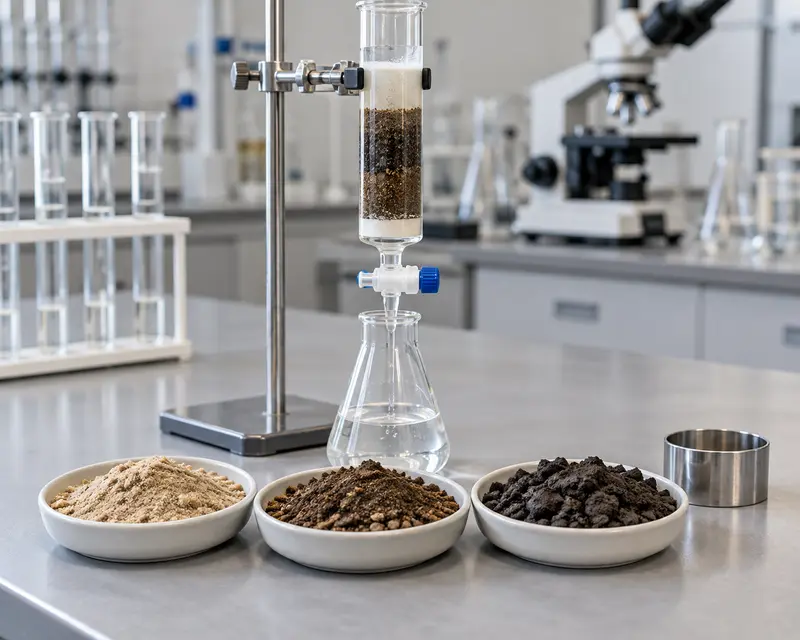
Cation exchange capacity is the amount of positive charge a soil can hold in exchangeable form under a defined test condition. It helps describe the soil’s exchange reservoir for ions such as calcium, magnesium, potassium and sodium. It is not a direct measurement of yield, nutrient sufficiency or the amount of fertilizer a crop should receive.
CEC is method-dependent. A value measured near the soil’s own pH and a potential value measured at a buffered pH do not answer exactly the same question. Texture, clay mineralogy, organic matter, pH, carbonates, gypsum and soluble salts also affect interpretation. A useful report therefore starts with the sample and method—not with a universal ‘low’ or ‘high’ label.
KEY TAKEAWAYS
- Compare CEC results only when sampling depth, preparation, method and unit are compatible.
- Read exchangeable cations and base saturation with pH, texture and crop requirements—not as a universal ideal ratio.
- Do not turn one CEC number into a fertilizer rate or a promise that one input will rapidly change the whole soil reservoir.
1. Define what the test measures
CEC is an amount of exchange capacity per mass of soil. The exchange sites occur mainly on clay minerals and soil organic matter; their charge and accessibility vary with mineral type and pH. A high capacity means that more cations can occupy exchange sites, but it does not say which cations are present, whether they are balanced for a crop, or whether roots can access water and nutrients under current field conditions.
2. Sample by management zone and depth
Separate fields or blocks with different texture, slope, drainage, liming, manure history, salinity or crop performance. Build one representative composite from consistent depth increments within each homogeneous zone. Do not mix topsoil and subsoil or a saline patch with a normal area. Record GPS or a repeatable map position so the same zone and depth can be sampled again.
Ask the laboratory whether carbonates, gypsum or soluble salts require a specific preparation or method. These materials can interfere with exchange measurements or inflate the sum of extracted cations. The method request should travel with the sample history rather than being chosen after an unexpected number appears.
3. Check the method and units
A report may show CEC at the soil’s actual pH, an effective CEC, or a potential CEC measured with a buffered extractant. Potential CEC can expose pH-dependent charge that is not expressed under current field pH. ISO methods also use different extractants and operating conditions. Therefore, a trend is defensible only when the same laboratory method and comparable sample preparation are retained.
The modern unit cmol(+)/kg expresses centimoles of positive charge per kilogram of soil. For CEC, its numerical value is equivalent to the older meq/100 g unit. Keep the charge notation: kilograms of calcium or potassium cannot be compared directly with a charge-based CEC number without equivalent-mass conversion.
4. Interpret CEC in the soil context
Sandy soils commonly have fewer exchange sites than clay- or organic-matter-rich soils, but clay type matters as much as clay percentage. Variable-charge surfaces also gain or lose charge as pH changes. This is why a fixed cross-soil target is misleading: compare a field with its own mapped zones, history and method, and interpret CEC beside particle-size analysis, organic carbon or organic matter, pH and electrical conductivity.
5. Read exchangeable cations and base saturation
Base saturation is the share of the measured exchange capacity occupied by base-forming cations, commonly calcium, magnesium, potassium and sodium under the laboratory’s definition. It must be calculated from compatible results on the same charge basis. A percentage can look acceptable while the absolute amount of one nutrient is inadequate, or it can hide excessive sodium. Read both concentration and share, together with crop guidance and salinity or acidity indicators.
Do not force calcium, magnesium and potassium into one universal ‘ideal’ ratio. Soil mineralogy, crop, rooting depth, water quality and analytical method change the decision. Use locally validated sufficiency and amendment guidance, and keep sodium diagnosis within the EC–SAR–ESP workflow rather than inferring it from CEC alone.
| Report item | Question to ask | Decision boundary |
|---|---|---|
| CEC | Which method, pH and unit? | Do not compare incompatible methods. |
| Exchangeable cations | Absolute charge and percentage? | One percentage does not set a fertilizer rate. |
| Base saturation | Same extraction and charge basis? | Check pH, salinity and crop context. |
6. Build a measured product decision
First identify the constraint that can be acted on: organic-matter management, pH correction, sodium risk, a measured nutrient need or a physical soil limitation. Then review the current local label and guaranteed analysis of the exact product lot. SOIL-G can be considered within a diagnosed soil-improvement programme and WSG Core within a compatible soluble route, but neither product name by itself proves a CEC change or supplies a universal application rate.
For validation, keep untreated comparison strips or matched zones, document the complete programme and measure crop response and the original constraint. Re-sample the same georeferenced depth with the same laboratory method at an agronomically meaningful interval. Treat CEC as a relatively stable soil descriptor unless repeated compatible measurements demonstrate otherwise; do not claim success from a short-term shift produced only by method, moisture or sampling location.
PRACTICAL ANSWERS
Frequently asked questions
Are cmol(+)/kg and meq/100 g the same for CEC?
Yes, their numerical values are equivalent for charge-based CEC reporting. Confirm that both results use compatible methods before comparing them.
Does a high CEC mean the soil is fertile?
No. It describes exchange capacity, not which ions occupy it, root-zone conditions, nutrient sufficiency or crop response. Read it with the complete soil test and field context.
Can a humic product rapidly increase the CEC of an entire field?
Do not assume it. The field-scale result depends on soil mass, product composition, rate, placement, persistence and method. Require a mass-balance rationale and repeated, compatible measurements rather than a general claim.
Should CEC determine fertilizer rate?
Not by itself. Fertilizer decisions also require crop demand, calibrated soil and tissue tests, expected yield, nutrient source, water, timing, loss risk and current local recommendations.
Technical references
- ISO 11260:2018 — CEC and base saturation with barium chloride
- ISO 23470:2018 — Effective CEC and exchangeable cations
- FAO Soils Portal — Chemical properties and CEC
- UMass Extension — Interpreting soil-test results
- University of Delaware — CEC and soil-test interpretation
- Berlin Environmental Atlas — Effective CEC method
This article provides product-selection and operating logic, not a legally binding application rate. Final use follows the registered label, batch documentation, water and soil analysis, and local technical guidance.