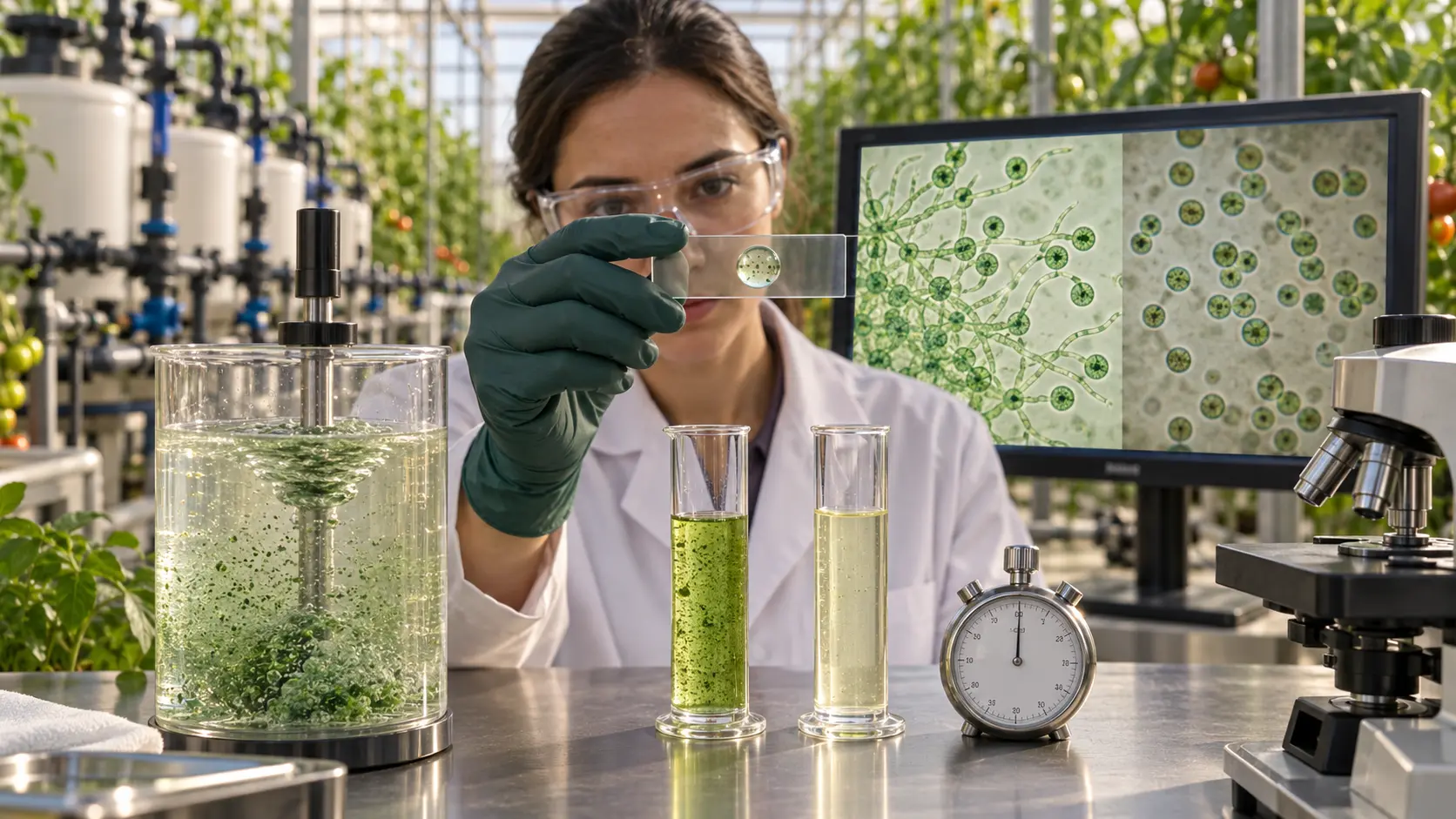
A mixture can remain clear and still be biologically incompatible. A conventional jar test can reveal flocculation, sediment or filter risk, but it cannot show whether Trichoderma conidia still germinate after exposure to the final water, fertiliser, crop-protection product or adjuvant. The useful compatibility question is therefore specific: does the declared organism remain recoverable after the actual mixing sequence and the longest realistic time in the tank?
Bio-TH WSG and Bio-TH+BS WSG can enter such a programme only where every applicable label permits the intended route. Compatibility must be demonstrated for the exact product lots, source water, partner inputs, concentrations, temperature, equipment and contact-time window. A result from another strain or published formulation is useful for designing the test, not for declaring the commercial mixture safe or effective.
KEY TAKEAWAYS
- Read every applicable label before any bench or tank test.
- Keep an untreated microbial control in the same source water and temperature.
- Sample viability at the real mixing, delay and application times.
- Release only the exact recipe tested; separate or reject everything else.
1. Make the label the first compatibility gate
List every component by commercial formulation, active or biological agent, lot, intended concentration and application route. Check whether either label prohibits the mixture, limits the route or requires separation. A laboratory screen cannot override a prohibition or create an unregistered use. If the relevant market treats the Trichoderma product as a fertilising product rather than a microbial plant-protection product, apply that market’s own requirements and claims boundary.
2. Freeze the water, recipe and controls
Use the source water planned for application and record temperature, pH, electrical conductivity, hardness or alkalinity where relevant, and any disinfectant residual that the applicable method can measure. Prepare each stock separately with the real agitation, filter and order of addition. At minimum, compare Trichoderma in source water with the complete final mixture. Add water-only, partner-only and formulation-carrier controls when they are needed to locate the cause of a change. Keep vessels, volumes, temperature and agitation identical.
3. Use the jar test only as a physical screen
Observe immediate and delayed haze, foam, floc, sediment, heat, pH or EC movement, filter residue and emitter flow with the same contact window planned for use. A severe physical failure is enough to stop the candidate. A visually acceptable result only means that the mixture passed this screen; it says nothing about conidial germination, viable recovery, strain identity, crop safety or biological function. Do not use colour or clarity as a substitute for microbiology.
4. Measure viability across the real contact-time window
Predefine samples immediately after mixing, after the normal filling delay and at the longest credible end-of-application time. If recirculation or an operational interruption is plausible, add that condition before the study starts. Use a matrix-appropriate validated method—such as conidial germination or viable recovery—and the same dilution, medium, incubation, counting rule and analyst controls for mixture and untreated control. Report raw replicate results and the mixture-to-control change rather than selecting a convenient plate.
An in-vitro method is a compatibility gate, not a field-efficacy test. Define acceptance criteria in the approved development protocol before reading the data, including how variability, reporting limits and an invalid control will be handled. If the untreated control also loses viability, investigate the water, handling, temperature and method before judging the tank partner.
5. Validate preparation, sanitation and equipment
A passing bench mixture can still fail operationally. Confirm that the Trichoderma formulation disperses under the actual make-up procedure, passes the intended screen or filter without disproportionate retention and remains suspended through the application. Document tank and line cleaning because residues from a previous antimicrobial programme can become an unplanned partner. Prepare only the volume supported by the validated contact window; do not assume an overnight hold is acceptable without label permission and direct data.
6. Write a bounded release, separate or reject decision
Bind the decision to exact product names and lots, water source, concentrations, order, temperature, filters, contact-time window, viability method and intended route. Then run a bounded crop-safety strip under the applicable label before commercial scale. Release only the tested recipe, require separate applications where timing removes an incompatibility, or reject the combination. Viable conidia after mixing do not prove disease suppression, root colonisation or yield response; those claims require their own controlled crop trial.
PRACTICAL ANSWERS
Frequently asked questions
Does a clear jar prove that a Trichoderma tank mix is compatible?
No. It supports physical compatibility only. Biological compatibility needs a validated viable-conidia or recovery comparison against an untreated control.
Can compatibility data from one Trichoderma strain be transferred to another?
Not as approval. Isolates and formulations can respond differently, so the exact commercial combination requires its own evidence.
Which contact times should be tested?
Use operational points: immediately after mixing, the normal delay and the longest credible time before the tank and lines are empty, plus any realistic interruption.
Can a prepared Trichoderma mixture be stored overnight?
Do not assume so. Prepare fresh unless every applicable label permits holding and direct data support viability and physical stability for that exact duration.
Does post-mix viability prove crop efficacy?
No. It is a compatibility gate. Biological performance requires a separate controlled trial for the intended crop, route and local conditions.
Technical references
- Peer-reviewed study: Trichoderma isolate sensitivity to environmental factors and fungicides
- Cornell University: Trichoderma biology and pesticide susceptibility
- OECD: Guidance for registration requirements for microbial pesticides
- FAO and WHO: Specifications manual for microbial pesticides
This article provides product-selection and operating logic, not a legally binding application rate. Final use follows the registered label, batch documentation, water and soil analysis, and local technical guidance.