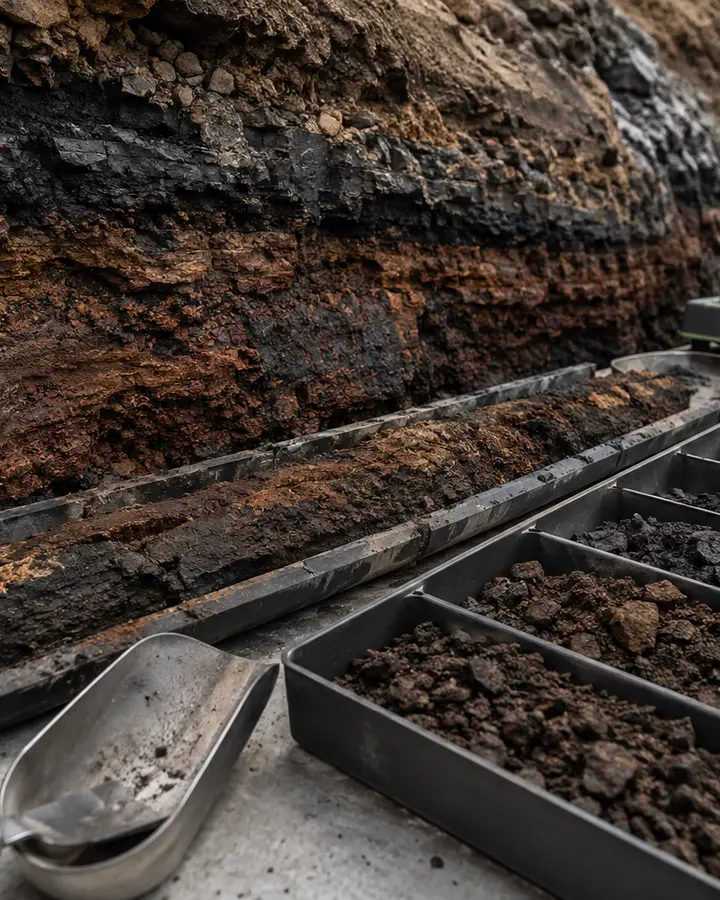
Leonardite is commonly described as naturally oxidized lignite rich in humic substances. That is a useful geological starting point, but not a purchase specification. Weathering, mineral dilution, seam variability, moisture and selective mining can make two dark samples behave very differently in extraction, granulation and direct soil placement.
A responsible qualification programme separates three questions: what the material is, how much of the relevant fraction is measurable by a stated method and basis, and whether the delivered lot is suitable for the intended process. No single colour observation, pH value or headline humic-acid percentage answers all three.
KEY TAKEAWAYS
- Leonardite is an oxidized lignitic material, but deposit name and dark colour do not prove process suitability.
- Compare humic results only when extraction method, reporting basis, moisture correction and sample preparation are stated.
- Representative composite sampling is the first quality test because a seam and stockpile are rarely uniform.
- Release each lot against the agreed specification, batch documentation and intended process—not a generic origin claim.
1. Leonardite and lignite are related, not interchangeable
Leonardite occurs in association with lignite deposits and is commonly treated as a strongly weathered or oxidized lignitic material. Oxidation introduces or exposes more oxygen-containing functional groups and generally increases alkaline extractability relative to less-weathered lignite. The boundary is not established by colour alone and terminology varies between deposits, suppliers and jurisdictions.
Do not confuse the natural raw material with potassium humate. Leonardite is the mined mineral–organic matrix; potassium humate is a processed salt produced after alkaline extraction and formulation. Natural granules such as SOIL-G and soluble concentrates such as WSG Core therefore belong to different product routes even when they share a source.
2. Why appearance and one headline value are insufficient
Black or dark-brown colour can support field identification, yet coal-rich lignite, wet fines and mineral-coated fragments may look similar. A pH measurement is equally context-dependent: solid-to-liquid ratio, water quality, equilibration time and sample preparation change the result. Neither observation replaces compositional and process tests.
A declared humic-acid percentage is not self-interpreting. Values can differ because of extraction reagent, separation conditions, detection method and whether the result is stated as received, on a dry basis or on an ash-free basis. Use the same documented method and basis for supplier comparison and lot release.
3. Build a raw-material qualification panel
| Control | What it answers | Responsible record |
|---|---|---|
| Representative sampling | Does the laboratory portion represent the seam, face, truck or stockpile? | Sampling plan, increments, composite method, date and lot identity |
| Moisture and dry-matter basis | How much delivered mass is water, and how are other results normalized? | Method, test temperature, result as received and on dry basis |
| Ash or mineral matter | How much non-combustible mineral dilution accompanies the organic matrix? | Declared furnace method, basis and lot result |
| Extractable humic fractions | How much method-defined fraction is recovered under stated conditions? | Extraction and separation method, basis, moisture correction and laboratory |
| Sulfur and target contaminants | Does the source meet market, process and safety requirements? | Validated method, applicable legal limits and lot-specific CoA |
| Particle size and process trial | Will the lot crush, dry, extract, granulate or spread as intended? | Sieve result plus controlled bench or pilot test using the intended route |
4. Control the sample before trusting the analysis
A grab sample from the top of a truck cannot describe a heterogeneous lot. Define the lot boundary, collect increments across depth and position, combine and homogenize them, then reduce the composite without selectively losing fines or wet material. Seal and identify retained reference samples so a disputed result can be investigated.
Track source face, extraction date, weather exposure, stockpile zone, truck, moisture condition and receiving lot. This chain of identity lets the plant distinguish geological variability from laboratory variation and process drift.
5. Translate raw-material data into the MetraHum product route
SOIL-G retains the non-extracted natural matrix, so particle distribution, moisture, ash, granule integrity and spreading behaviour are central. WSG Core and WSP B2B depend on controlled extraction, separation, concentration and drying, making extractable fraction, mineral load and insoluble residue important. K18 and BLACK-S add liquid or suspension controls such as stability, redispersibility and filtration. A raw-material approval therefore belongs to a defined product route, not to the whole portfolio without qualification.
Final product selection, use rate, timing and compatibility must follow the registered label, lot-specific documentation, soil and water analysis, equipment validation and local technical guidance. Raw-material origin does not by itself establish agronomic performance or a universal dose.
6. Use a documented incoming-lot release workflow
- Define the lot and verify source, transport and chain-of-custody records.
- Collect and retain a representative composite sample before unloading or blending removes traceability.
- Review the lot CoA against the agreed method, basis and acceptance limits.
- Confirm identity and critical properties with receiving tests and a defined process trial where required.
- Release, quarantine or reject with an authorized record; investigate trends rather than only individual failures.
PRACTICAL ANSWERS
Frequently asked questions
Is leonardite the same as lignite?
They are related, but not interchangeable. Leonardite is commonly described as a more strongly oxidized or weathered lignitic material with greater alkaline extractability. Because terminology and deposits vary, confirm identity and suitability with a documented analytical and process specification.
Can high-quality leonardite be identified by colour?
No. Colour is only a field observation. Moisture, coal-rich fragments and mineral coatings can produce similar appearances. Use representative sampling plus method-defined moisture, ash, sulfur, humic-fraction, particle-size and contaminant controls appropriate to the intended product route.
Is the highest humic-acid percentage always the best raw material?
No. First confirm that results use the same extraction method, reporting basis and moisture correction. Then assess mineral load, sulfur, contaminants, particle behaviour, process yield and consistency. The best lot is the one that meets the complete route-specific specification, not one isolated number.
Is leonardite the same as potassium humate?
No. Leonardite is a natural mineral–organic raw material. Potassium humate is an extracted and formulated potassium salt of humic fractions. Verify the product identity before choosing direct soil placement, dissolution, fertigation or formulation use.
Which MetraHum products are connected to leonardite quality?
SOIL-G uses the natural matrix directly. WSG Core, WSP B2B and K18 use processed humic routes, while BLACK-S follows a suspension route. The critical raw-material and finished-product controls differ for each. Final selection and use must follow the registered label, lot documents, soil and water analysis and local technical guidance.
Technical references
- Scientific Reports — Extraction and chemical characterization of humic acid from lignite coals
- ACS Omega — Oxidation and humic-acid characteristics of lignite
- USDA Agricultural Marketing Service — Oxidized lignite technical report
- International Humic Substances Society — Isolation procedures
This article provides product-selection and operating logic, not a legally binding application rate. Final use follows the registered label, batch documentation, water and soil analysis, and local technical guidance.